
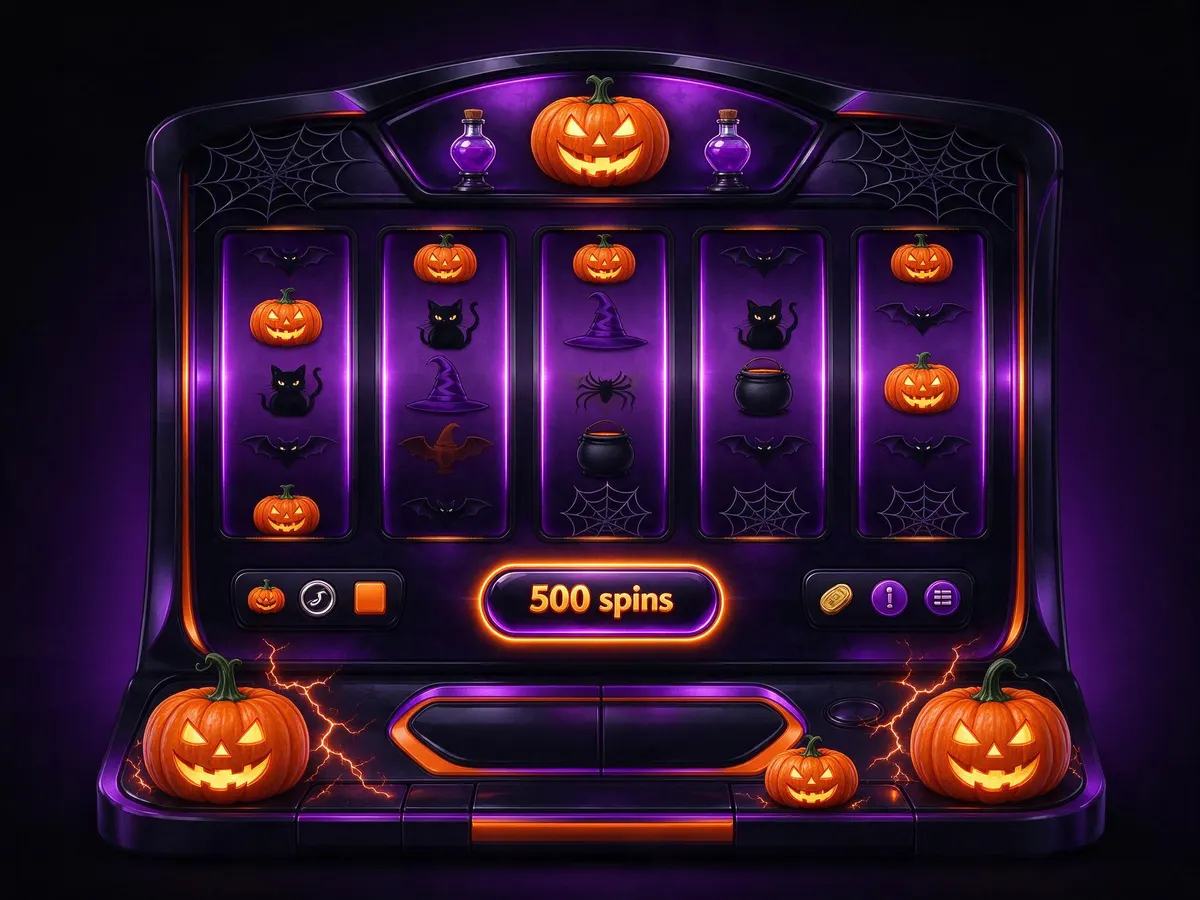
Real Deal in one line, and why one line isn’t enough
BGaming’s Real Deal lets players buy a block of 500 spins for less than the cost of 500 spins bought one at a time. It debuts in Noche de Almas, one of five new Halloween slot games the studio released this October for operators and players.
That single sentence covers everything the announcement actually confirms, which is the problem. A discounted per-spin price sounds like a straightforward improvement, and it might be. But a lower price per spin only improves what you get back if the prize scale attached to those spins is unchanged. The release doesn’t say whether it is. Hold that thought, because it decides whether Real Deal is a genuine change to the math or a new way of packaging a session.
The five games in BGaming’s Halloween set
The seasonal pack contains five titles, spread across what BGaming describes as its three game worlds:
- Witchcraft Riches
- Chicken Halloween
- Aviamasters 2 Halloween
- Spider Circus Hold and Win
- Noche de Almas
Two of them are openly seasonal reworks. Chicken Halloween is the Halloween version of BGaming’s Chicken Shot, and Aviamasters 2 Halloween is the Halloween version of Aviamasters 2. That matters more than the art does: a reskin inherits the engine, the paytable and the behaviour of the original, so if you’ve played Chicken Shot you already know roughly what Chicken Halloween does between the pumpkins.
The thematic tie is the obvious one. Witches, spiders, a Day of the Dead flavour in Noche de Almas, orange and purple everywhere. The commercial logic is just as obvious. October is when search traffic for halloween slot games peaks and when operators want a themed lobby row to promote, so studios ship seasonal packs on a predictable annual clock. Nothing wrong with that. It just means the release date tells you about the calendar, not about the quality of the games.
One detail worth getting right: Real Deal debuts in Noche de Almas. The announcement doesn’t state that the other four titles carry the feature, so don’t assume a five-game rollout until an operator’s game info screen says otherwise.
How the Real Deal purchase works
What starts it
Real Deal is player-initiated, not triggered by symbols. You choose to buy the 500-spin package rather than landing scatters or filling a meter to unlock it. That makes it closer in shape to a bonus buy button than to a free spins round, even though what you’re buying is different.
What the announcement does not specify: the price of the package, the stake level the 500 spins run at, whether the discount is a fixed percentage or scales with stake, whether the spins auto-play or are banked for manual use, and whether the package can be bought mid-session or only from a fresh balance. Those are not small gaps. Until the game’s own help screen is visible on a licensed site, treat the mechanic as “buy 500 spins cheaper” and nothing more precise.
What you’re actually holding once you buy
You’re holding a prepaid block of base-game spins at a known total cost. Two consequences follow from that structure alone, independent of any unpublished detail.
The first is arithmetic. If the paytable and hit frequency behind those 500 spins are identical to normal play, paying less per spin means more expected return per unit staked, because the return side of the equation hasn’t moved. If instead the prize scale is reduced to match the cheaper price, the house edge sits where it always sat and the discount is cosmetic. The announcement doesn’t resolve which of those two it is, and I wouldn’t guess. Ask the game info panel.
The second is behavioural, and it runs the other way. Buying 500 spins up front converts a long series of small decisions into one large decision, taken before you’ve seen a single result. Normal play lets you stop after spin forty. A prepaid block doesn’t. That is a real cost that no RTP figure will show you.
Where Real Deal sits next to free spins, multipliers and bonus buy
Most slot bonus features change what happens during a round. Real Deal changes what you pay for a quantity of ordinary rounds. Lined up against the familiar mechanics, the difference is clear.
| Mechanic | What you pay | What you get | Effect on the math |
|---|---|---|---|
| Free spins | Nothing extra; triggered in play | A set number of spins, often with modifiers | Built into the game’s published RTP |
| Multiplier | Nothing extra; awarded in play | Wins scaled by a factor | Raises variance, already priced into RTP |
| Bonus buy | A premium, typically a large multiple of the stake | Immediate entry to the feature round | Usually a separate published RTP for bought entries |
| Real Deal | Less than 500 single spins would cost | 500 base-game spins as one package | Not published in the announcement |
So the genuinely new part is the direction of the price change. Bonus buy asks you to pay more for a shortcut; Real Deal asks you to pay less for volume. Everything else about it, the player-initiated purchase, the fixed outlay, the up-front commitment, is familiar territory repackaged.
A working checklist for any seasonal slot release
Use the same five checks on any new slot, seasonal or not. They take about two minutes on the game info screen.
- Find the published RTP, and find out whether there is more than one. Games with purchase mechanics often carry a different figure for bought rounds than for base play. If a site shows no RTP at all, that is information too.
- Check the volatility rating and any hit frequency disclosure. Volatility tells you how the same RTP gets distributed; a high volatility game can run cold for hundreds of spins without anything being wrong.
- Work out whether it’s a reskin. Chicken Halloween and Aviamasters 2 Halloween are declared reworks of existing titles, which is useful honesty. Look up the original’s numbers and you’ve already done most of your homework.
- Look at the provider’s track record and testing. BGaming is an established studio with wide operator distribution, which tells you the RNG and paytables go through the usual certification. It tells you nothing about whether a specific game suits you.
- Confirm it’s live on a licensed platform in your jurisdiction, and check the terms before depositing. Seasonal promos get pushed hard in October by sites that aren’t always licensed where you are.
Whether it’s worth your time
Worth a demo spin if you’re curious, not worth a deposit chased purely for the novelty. The theme is seasonal dressing, two of the five games are versions of titles you may already know, and the one actually new mechanic is a pricing structure rather than a new way of winning. None of that makes the set bad. It makes it a normal October release that happens to carry one interesting experiment.
The experiment is interesting enough to follow up, though. If the 500-spin package truly keeps the standard paytable at a reduced price, it’s one of the few purchase mechanics that moves in the player’s favour rather than against it. If it doesn’t, it’s a budget tool wearing a discount label. The announcement doesn’t settle it, and the only place that will is the game’s own information panel once Noche de Almas is live on sites you can legally use.
Whatever the answer turns out to be, set your stake and your loss limit before you open it, and remember that a cheaper spin is still a spin with a house edge on it. If a prepaid block of 500 would be uncomfortable to lose in full, that’s the number telling you not to buy it. Most licensed operators offer deposit, loss and session limits, plus cool-off tools, and they’re worth setting up before a seasonal lobby row tempts you into a game you hadn’t planned to play.