The first real casino game a new player tries is increasingly a table, not a slot
Live dealer roulette, blackjack and baccarat have become the format a large share of online casino newcomers reach for before anything with reels. That is the practical explanation for the popularity of live dealer table games among people who have never set foot in a physical casino: a streamed table asks less of a beginner than a slot with four bonus mechanics and a 20-page paytable.
The news hook comes from AGS. At G2E 2026, the supplier’s interactive division put a proposition in front of the industry through CDC Gaming: putting table games online does not cannibalise the casino floor, it broadens who plays them. “The addition of Bonus Spin Xtreme to our table products has actually changed the demographic of who’s playing our table games,” said Zoe Ebling, vice president of AGS Interactive. That sentence is doing a lot of work, and it is worth being precise about how much of it the evidence actually supports.
What AGS actually said about online tables feeding land-based play
AGS reported a broadening of its table game audience through digital channels, not a measured count of players who went online and then walked into a casino. The CDC Gaming report on AGS Interactive is the source for the figures that follow, and those figures describe distribution and demographics rather than footfall.
The verifiable parts: AGS has developed more than 100 real-money online themes, with more than 50 of its online games also available in land-based casinos. Bonus Spin Xtreme, the first concentric wheel progressive for table games, went live online in four US states and two Canadian provinces under an exclusive deal with Rush Street Interactive, with more partners due in 2027; over 1,000 land-based units have been installed since its 2020 debut. AGS’s Single Deck Blackjack took the Eilers & Krejcik Gaming award for top-performing new online table game this year. Ebling also noted that online placements succeed “even with iGaming table minimums often less than $1,” and that the company sees “a really high hold on table products.”
So there are two defensible readings. The cautious one: a supplier with the same titles in both channels naturally sees the same brands recognised in both, which is a catalogue effect rather than proof that online play drives visits. The stronger one, which I think is closer to right: a sub-$1 digital table minimum lets someone learn a game at a cost where learning is affordable, and people who know a game are far more likely to play it anywhere. The second reading doesn’t make the first stupid. It just explains the mechanism better. What nobody has published is the number that would settle it.
Why does a streamed croupier feel safer than RNG software?
Because a human dealer answers the “is this rigged?” question visually, in real time, which no RNG certificate does for a nervous first-timer. The maths is identical either way and both formats are audited, but a wheel you watch being spun removes a doubt that a line of code cannot.
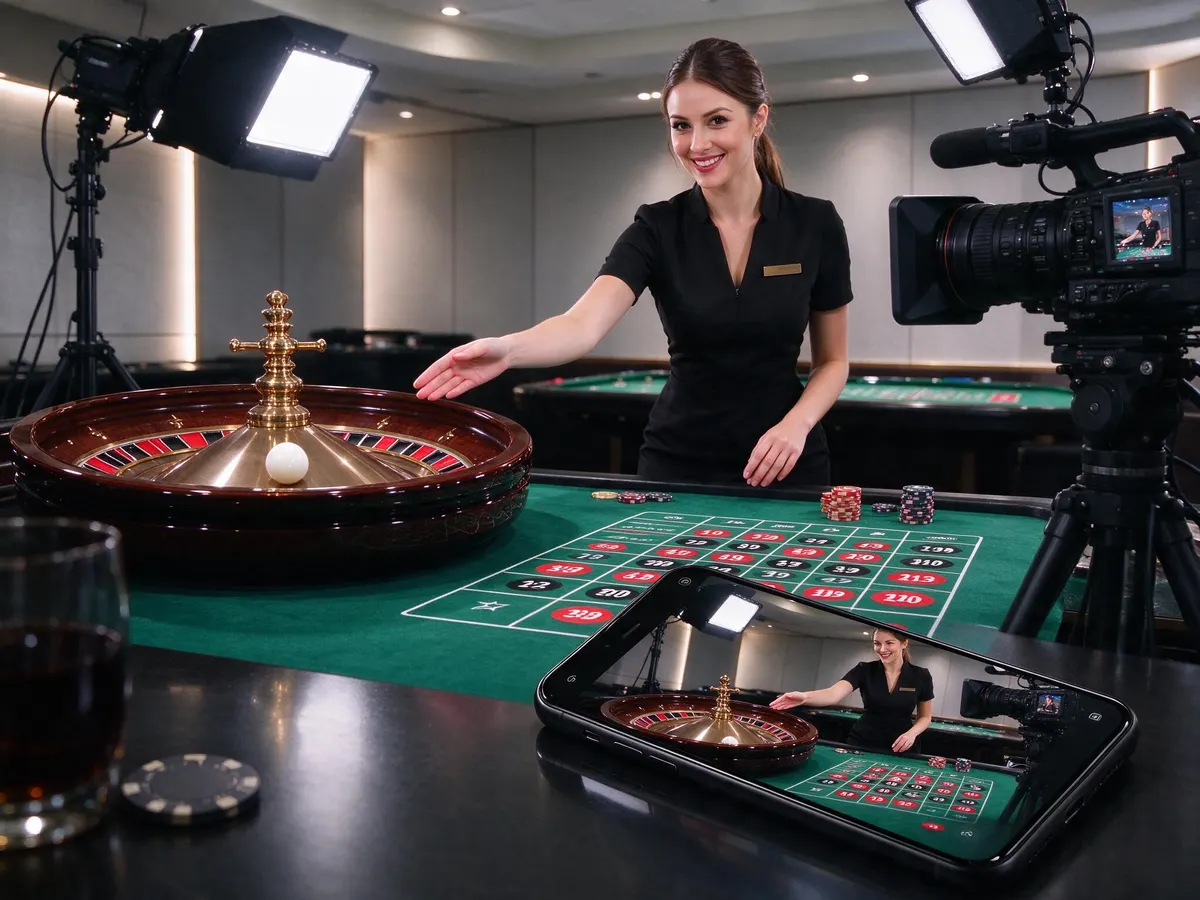
You can see the ball drop
RNG table games are random, independently tested, and in every meaningful sense fair. They are also opaque to someone who has never been inside a casino. A live dealer stream replaces trust-by-certification with trust-by-observation: the shoe, the cards, the croupier’s hands. For a player migrating from slots, where the result appears with no visible cause at all, that shift matters more than any technical assurance.
You can watch a table before you sit at one
Live lobbies let you open a table and observe. You see what others bet, how long a round takes, where chips go, when betting closes. None of that is available at a physical table without standing behind strangers and looking conspicuous. Add bet limits that commonly start far below a casino floor’s minimum, and the cost of being a beginner collapses. That, more than any marketing, is what pulled table games out of their reputation as the intimidating end of the casino.
Why roulette, blackjack and baccarat and not slots or poker?
Because all three can be played competently after one explanation, and all three let a beginner bet on an outcome with two or three possibilities. Red or black. Player or banker. Hit or stand. Poker demands reading opponents; slots hide their mechanics behind features; these three do not.
The house edge on the simple bets is also published and stable, which is exactly what a new player should be comparing. Rules affect these numbers, so check the specific variant at your table.
| Game / bet | House edge | Condition |
|---|---|---|
| European roulette (single zero) | 2.70% | All standard bets |
| American roulette (double zero) | 5.26% | Most bets |
| Blackjack, basic strategy | ~0.5% | Six decks, dealer stands on soft 17 |
| Baccarat, banker | 1.06% | Eight decks, 5% commission |
| Baccarat, player | 1.24% | Eight decks |
| Baccarat, tie | ~14.4% | Paying 8:1 |
Blackjack: the one game with a correct answer
Live dealer blackjack trends upward partly because it rewards study in a way slots cannot. Basic strategy is a fixed chart, not a system, and it reduces the edge to roughly half a percent under common six-deck rules. It does not beat the game and nothing does, but a beginner can see their decisions improving an outcome, which is a different and more durable kind of engagement than waiting on a bonus round. The trap is the side bets sitting either side of the main box; those typically carry an edge several times higher than the hand itself.
Baccarat: two bets and almost nothing to learn
Baccarat asks the player to choose between two outcomes and then does everything else automatically. There are no decisions to get wrong, drawing rules are fixed, and banker at 1.06% is among the lowest edges on any casino floor. The tie bet, at roughly 14.4% when it pays 8:1, is the single worst thing on the table and is marketed the hardest. I wouldn’t place it.
How confidence travels from a laptop to a physical pit
The crossover works through familiarity with procedure, not improved odds. Someone who has played 200 hands of live blackjack knows when betting closes, what the dealer’s signals mean, how splits and insurance are offered, and what a shoe looks like mid-game. Walking up to a physical table, the only new variable is the people.
That is the honest version of AGS’s claim, and the reason the “online tables boost land-based play” line is probably directionally true even though the presented evidence stops short of demonstrating it. One caveat that belongs in the same breath: the same interview describes “a really high hold” on table products. A gateway that works for the player and a gateway that works for the operator are the same gateway. Nothing about learning a game cheaply changes the fact that every bet listed above carries a negative expected return over time.
Where Indian players sit in this pattern
Indian online casino audiences show the same pull toward live dealer formats, helped along by locally familiar live tables such as Teen Patti and Andar Bahar sitting in the same lobbies as roulette and baccarat. Treat that as an observable preference rather than a measured statistic; the AGS figures above cover North America, South America and Europe, not India.
The legal position deserves a flat statement. As of August 2025, India’s Promotion and Regulation of Online Gaming Act, 2025 imposed a nationwide ban on online real-money gaming, overriding the previous state-by-state framework rather than merely varying by state, so check what currently applies where you live before depositing anything. Set a deposit or loss limit before you start, treat the money as spent, and use the operator’s cool-off or self-exclusion tools if play stops feeling like play. This is entertainment with a built-in cost, not a source of income.
What to check before you sit down at a live table
- Confirm the operator’s licence and which regulator issued it, before you deposit rather than after.
- Read the table’s minimum and maximum bet, then pick one you could lose 20 rounds of without caring.
- Identify the variant: single zero or double zero roulette, how many decks, whether the dealer hits soft 17, what the commission is on banker bets.
- Find the side bets and decide now whether you are playing them, because the moment to decide is not mid-shoe.
- Fix a bankroll figure and a stop point before the first spin, not during a losing run.
- Use chat politely or not at all; dealers are working, and tipping is optional at most live studios.
The open question is the one AGS’s presentation raised without answering: how many online table players actually turn into casino-floor players, and in what direction the traffic mostly runs. Until a supplier or operator publishes that number, the gateway argument stays a well-reasoned inference. What you can verify yourself is the edge on the bet in front of you, which is the part that decides how long your money lasts.