Stake has no New Zealand licence yet, and that is exactly the point
Stake confirmed in October 2026 that it wants into New Zealand’s newly regulated online casino market. According to G3 Newswire’s report of 13 October 2026, the operator is among a small group of companies that have progressed through New Zealand’s licence auction process, which gives it the chance to apply for a licence under the new framework. Licences have not been granted. The market is expected to launch from 1 December 2026, when licensed operators can begin trading, subject to the licensing process and regulatory approvals being completed.
That gap between “wants in” and “is in” is the most useful thing in the story, and it is a neat way into online casino licensing trends generally. One of the most recognisable brands in online gambling, running since 2017, still has to queue up, pay, apply and be approved before it can legally take a bet from someone in Auckland. Brand size buys none of that. The approval does.
What “newly regulated” means in New Zealand, and what it doesn’t
New Zealand is moving from a situation where residents could play on overseas sites without a local licensing regime for online casino to one where operators must hold a licence issued under a new framework, with a limited number awarded through an auction process. Per the G3 report, Stake has cleared that auction stage, which earns the right to apply rather than the right to operate.
Beyond that, be careful with detail. Licence counts, conditions, tax treatment, advertising rules and launch dates move during implementation, and the reporting on Stake’s interest does not spell them out. If a specific rule matters to you, read it from the source: gambling regulation in New Zealand sits with the Department of Internal Affairs, and the regulator’s own publications are the only version worth quoting. Anything you read on an affiliate page about NZ licence specifics, including this one, is secondary.
Myth: a famous brand is a vetted brand
Recognition and regulatory approval are unrelated. A brand can be enormous, sponsor teams you watch, and still operate in markets where nobody has checked its anti money laundering controls, its game audits or how it holds customer funds. Stake’s own path shows the distinction: it grew to global scale first, and is now working through formal licensing in market after market, with New Zealand following expansion into Argentina and Mexico during 2026 as part of its Latin America growth.
That pattern is the trend worth watching. Operators that built audiences in loosely governed conditions are increasingly applying for licences in markets that formalise, because legal access, payment partners, advertising and sponsorship all depend on it. Licensing has become the price of staying in the mainstream.
What a licence usually forces an operator to do
Conditions vary by jurisdiction, but licensed operators are typically required to verify customer identity and age (KYC) before meaningful play or withdrawal, to run anti money laundering monitoring and report suspicious activity, to submit games and random number generators for independent testing, to keep player funds separate from operating money, to offer deposit, loss and session limits plus self exclusion, and to accept a defined complaints and dispute process that ends with the regulator rather than with the operator’s own support team.
What a licence does not promise
A licence is a floor, not a verdict on quality. It does not mean fast payouts, sane bonus terms, good customer service or games you will enjoy. Plenty of licensed operators attach 40x wagering to a welcome offer, cap maximum cashout at a fraction of what players expect, or take a week to process a withdrawal during verification. The licence tells you there is a referee. It does not tell you the match will be fun.
Licensed or offshore: what actually changes for the player
The practical difference is recourse. With a licensed operator you have a named regulator to escalate to, defined rules the operator broke or didn’t, and in most frameworks a requirement that your balance is held separately from the business. With an unlicensed or offshore site, your protection is whatever the operator chooses to give you, and the only pressure available is public complaint.
| Protection | Licensed in your market | Offshore or unlicensed |
|---|---|---|
| Dispute escalation | Regulator or appointed ADR body after internal complaint | Operator’s own decision is usually final |
| Player funds | Commonly required to be segregated from operating funds | No standard requirement; depends on the operator |
| Game fairness | RNG and RTP testing by accredited labs as a licence condition | Varies; may be tested, may be self declared |
| Age and ID checks | Mandatory KYC, enforced before withdrawal or play | Often minimal until a large cashout is requested |
| Responsible gambling tools | Limits, cool off and self exclusion required | Optional, and self exclusion may not be honoured |
| If the site closes | Regulator involvement, though recovery is not guaranteed | Realistically, little or no path to your balance |
The honest risk with offshore betting operators is not that every one of them is a scam. Most pay most people most of the time, which is precisely why the model survives. The risk is concentrated in the tail: the disputed bonus term, the voided win, the account locked at verification, the closure. Those are the moments when “who do I complain to” becomes the only question that matters, and offshore is where that question has no answer.
How to check if an online casino is properly licensed
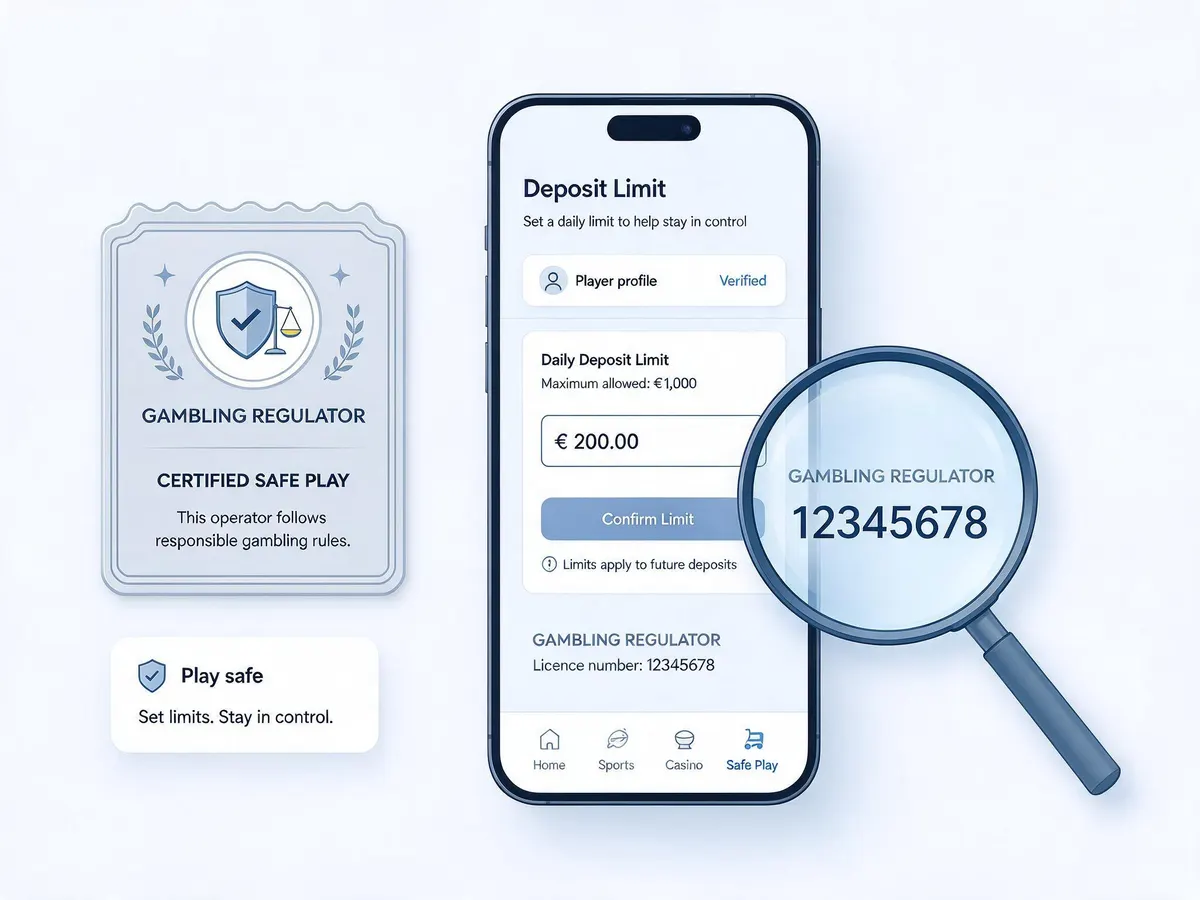
Find the licence number in the site footer, note which regulator issued it, then look that number up on the regulator’s own public register rather than trusting the badge on the page. Confirm the licence actually covers players in your country, and check that deposit limits and self exclusion exist in the account settings.
- Scroll to the footer and read the licensing line: it should name a regulator, a licence number and the legal entity holding it.
- Open the regulator’s website directly, by typing the address, and search its register for that number and company name.
- Check the status and scope. A licence can be suspended, expired, or valid for a different jurisdiction or product than the one you are using.
- Verify your own country is covered. Many sites hold a licence somewhere and accept players from everywhere, which is not the same thing.
- Look inside the account tools. Working deposit, loss and session limits, plus cool off and self exclusion, are a reliable sign the operator is actually supervised.
- Read the bonus terms before depositing: wagering multiple, game weighting, max bet while a bonus is active, and max cashout.
The trade-off the licensing story usually skips
Regulated markets cost players something real, and pretending otherwise makes the advice easy to dismiss. When a market formalises, the game catalogue often shrinks, bonuses get smaller and more tightly conditioned, verification arrives earlier and demands more documents, and some payment methods disappear. Players who liked a site before licensing frequently find it duller afterwards. That is not a myth; it is the direct result of the same rules that create the protections.
So there are two defensible readings. One says the friction is the product: you are paying in convenience for a referee, audited games and a balance that is not simply the operator’s cash. The other says that for a small, careful recreational player who never disputes anything, the protections rarely get used, and the better offers offshore are worth more than insurance they never claim.
I think the first reading wins, and not because the second is foolish. It is that the cost of being wrong is wildly asymmetric. A tighter bonus costs a known, small amount. A locked account holding a four figure balance on a site with no regulator costs everything in it, and you only learn which kind of operator you chose at the moment you need the answer. Paying a little tax on convenience to avoid an unbounded loss is a reasonable deal.
Applying the Stake example to any platform you’re judging
Treat regulated market entry as the signal and marketing as noise. Stake casino is advertised everywhere, has been running since 2017 and is now pursuing a New Zealand licence it does not yet hold, which means the only honest statement a New Zealand reader can make today is that the application stage has been reached. Apply the same standard to every brand: not how often you see the logo, but which regulator lists it, under what number, covering which country.
That standard travels. It works for a crash game site you found in a stream chat as well as for a sponsor on a shirt. And it leaves the New Zealand question properly open, because licences have not been issued and a 1 December 2026 launch depends on approvals that are still outstanding. Watch the register, not the press release.
Whatever platform you land on, licensed or not, the maths does not change: every casino game carries a house edge, and outcomes over any short period are mostly variance. Set a deposit limit before you play, treat the spend as entertainment money you can afford to lose, and use the self exclusion and cool off tools if play stops feeling optional. If gambling is causing harm, contact a local support service in your country.