
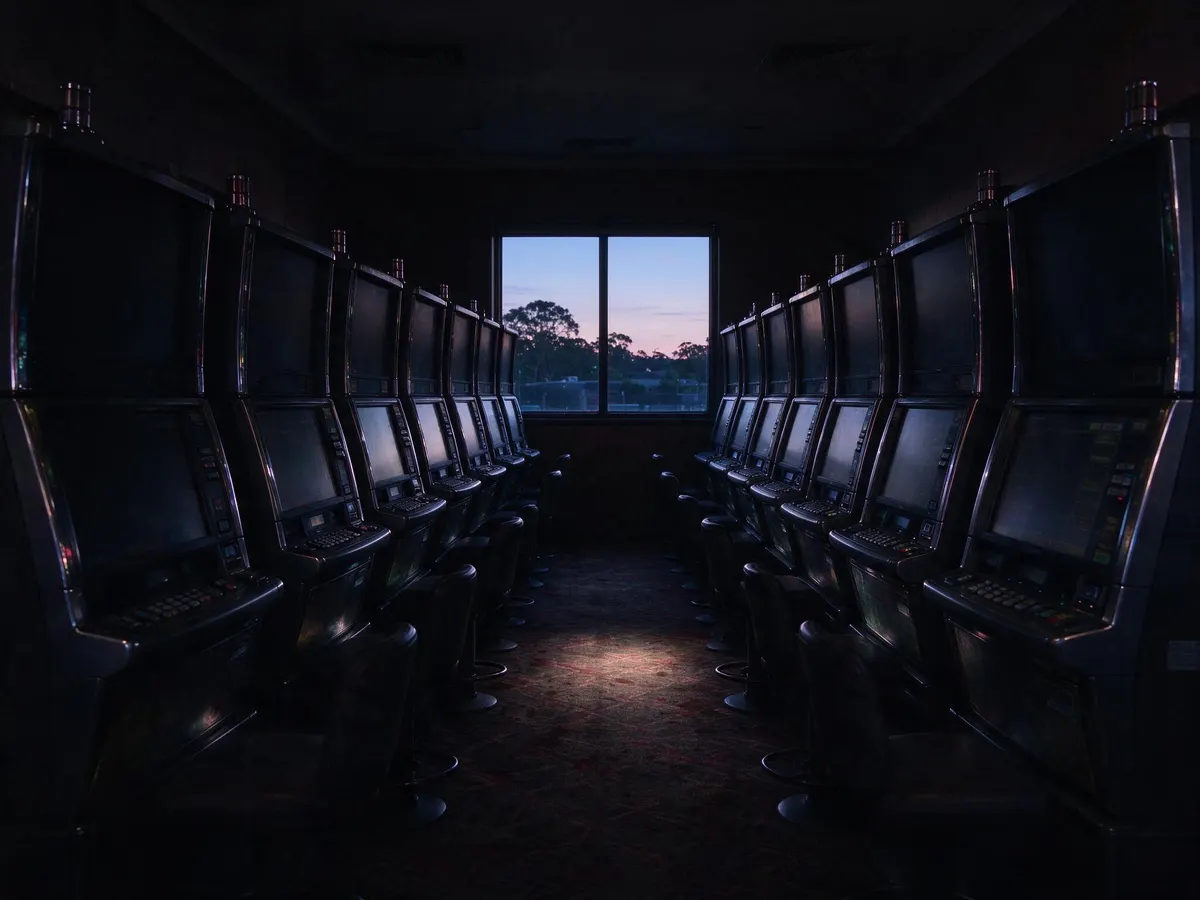
The rule was already law. The exemptions made it optional.
Mandatory shutdown hours for poker machines are not new in New South Wales. What changed is who they apply to. Until April 2026, more than 650 pubs and clubs held exemptions that let them run gaming machines straight through the overnight break. The NSW Government removed those exemptions, and by October 2026 Liquor & Gaming NSW had an intelligence-led operation underway to check whether venues are actually switching the machines off between 4am and 10am.
That sequence matters more than the hours themselves. It is the clearest recent illustration of how responsible gambling regulations work in practice: a harm-minimisation rule exists on paper, a carve-out quietly hollows it out, and the regulator’s real work is closing the carve-out and then proving compliance venue by venue. Most commentary on gambling reform fixates on the text of the rule. The NSW case says the text was never the binding constraint.
What Liquor & Gaming NSW is actually enforcing
L&GNSW is enforcing the requirement that gaming machines in licensed NSW venues be switched off daily between 4am and 10am, using a targeted inspection campaign rather than blanket auditing. The operation forms part of the NSW Government’s broader rollout of gaming reforms.
The reported scope, as of mid-October 2026: 51 venues reviewed across Sydney, the Hunter and the North Coast, with a further 70 venues under assessment as inspections continue over the following months. Fines were issued to the Crown Hotel in Camden and East Cessnock Bowling Club, along with at least one official caution. The report does not specify penalty amounts, so treat any figure you see quoted elsewhere as unverified until it appears in an L&GNSW statement.
Two details are worth holding onto. First, “intelligence-led” means the regulator is choosing targets from data and tip-offs, not walking the state alphabetically. Second, 51 reviews against a venue population in the thousands tells you this is a signalling exercise as much as a detection one.
What are pokies shutdown hours?
Pokies shutdown hours are legally mandated periods during which gaming machines in licensed venues must be switched off. In New South Wales that window runs from 4am to 10am every day. The rule governs the machines, not the venue: a pub can keep trading and serving, but the pokies stay dark for those six hours.
The reasoning behind the window is specific. It is not a moral objection to gambling at dawn. It targets the hours when a session has usually stopped being a decision and started being momentum: long sittings, fatigue, alcohol, and the point at which someone down for the night starts playing to get even rather than to be entertained. Removing the opportunity is cruder than treating the behaviour, but it is also the only lever a venue-licensing regulator genuinely controls.
Why regulators treat a forced break as a safeguard
Mandated downtime works on the premise that continuous play is itself a risk factor, independent of how much money is at stake. Pokies are fast, repetitive and designed to be absorbing; a player can complete hundreds of spins an hour with no natural stopping point built into the format. A shutdown inserts a stopping point that the game will never provide.
That is the harm-reduction logic regulators cite, and it is a reasonable one. It also has an obvious ceiling. A six-hour break does nothing about the eighteen hours either side of it, and a player determined to continue can walk to a venue in a different licensing jurisdiction or open an app. Forced breaks reduce exposure at the highest-risk end of a session. They do not reduce intent.
The tools that sit alongside shutdown hours
Shutdown windows rarely operate alone, and they are not designed to. The surrounding toolkit in most mature jurisdictions includes:
- Self-exclusion registers that bar a player from venues or online accounts for a fixed term, enforced by the operator rather than the individual
- Deposit, loss and session limits that a player sets in advance, when they are calm, and cannot raise instantly
- Cool-off and time-out facilities that pause an account for days or weeks
- Staff intervention training, so venue employees can identify and approach patrons showing distress signals
- Advertising, inducement and cash-access restrictions that reduce the triggers around the machine itself
The pattern across all of them is the same: put a gap between the impulse and the next bet. Shutdown hours do it with a clock, limits do it with a pre-commitment, self-exclusion does it with a register. A regulator relying on only one of these is relying on the weakest version of the idea.
How other regulators attack the same problem
Slot machine regulation elsewhere tends to target the machine’s economics and speed rather than the venue’s clock. Broadly, the controls fall into a handful of families, and jurisdictions mix them differently.
| Control type | What it changes | Main limitation |
|---|---|---|
| Stake caps | Maximum loss per spin or per hour | Does not shorten session length |
| Minimum spin speed | Rounds per hour, and total money cycled | Easily offset by playing longer |
| Shutdown or trading-hour limits | Window of availability | No effect on other hours or other channels |
| Account-based or cashless play | Links spend to an identity and a pre-set limit | Privacy objections; needs universal adoption |
| Machine caps and venue licensing | Density of machines in a community | Slow to bite; grandfathered entitlements |
Britain’s Gambling Commission, for example, has used both stake restrictions on betting-shop terminals and product rules for online slots covering features such as autoplay and minimum spin duration. Several Australian states apply their own machine shutdown windows, and the hours and exemptions differ from NSW’s. Because these rules change and because exemptions are where the detail hides, check the relevant regulator directly, such as the Gambling Commission or your state licensing authority, before relying on any specific figure.
Enforcement is where the policy actually lives
A gaming compliance regime is only as strong as the chance of being caught, which is why the NSW operation is more informative than the rule it enforces. L&GNSW has three practical instruments: inspection, financial penalty, and conditions attached to the licence itself. The third is the one venues fear, because a licence condition follows the business rather than the balance sheet.
The April 2026 exemption removal illustrates the point. For as long as 650-plus venues could legally run machines through the shutdown window, the rule’s measurable effect on gambling harm was limited to the venues it bound. No amount of inspection fixes a carve-out. Equally, a universal rule with no inspection programme is just a statement of intent, which is presumably why the regulator moved from one to the other within six months.
This is the part that gets underweighted in regulatory debate. The honest comparison is not “rule versus no rule” but “rule plus credible detection versus rule plus hope”. On that measure a modest restriction applied to everyone and audited occasionally beats an ambitious restriction riddled with exemptions, and it is not close.
Where time-based rules run out of road
There are two defensible readings of the NSW shutdown enforcement. The first treats it as real harm reduction: a hard stop at the hours when judgement is worst, now applied without exception and backed by inspections and fines. The second treats it as displacement theatre, since a player locked out of a pub at 4:30am has an online casino in their pocket, open permanently, with no closing time to enforce.
The second reading is not silly, and anyone dismissing it has not looked at the channel shift of the past decade. But it proves less than it claims. Displacement is not conservation; not every interrupted session resumes online, and the fact that one channel leaks is a weak argument for leaving the other wide open. The more defensible conclusion is that clock-based rules are a floor, worth having and cheap to enforce, that stop working the moment the product is available on a device.
That is precisely why online slots regulation has had to abandon the clock and build the same gap out of the account instead: deposit and loss limits, reality checks, session reminders, time-outs, self-exclusion that spans operators. The mechanics being restrained are identical. An online slot with a 96% RTP carries a 4% house edge that applies every hour of every day, and the maths does not pause at 4am any more than the player’s impulse does. If you want to understand what a shutdown hour is doing, think of it as the land-based substitute for a deposit limit: a constraint the player did not have to choose in the moment.
What the NSW case leaves unresolved is whether the inspections continue once the news cycle moves on, and whether anyone measures where the interrupted play went. Both questions are answerable. Neither has been answered yet. If you are reviewing your own play rather than the policy, the account-level tools are the ones you control: set deposit and loss limits before a session, use a time-out if a session stops feeling voluntary, and contact a local gambling help service if it does not stop there.