
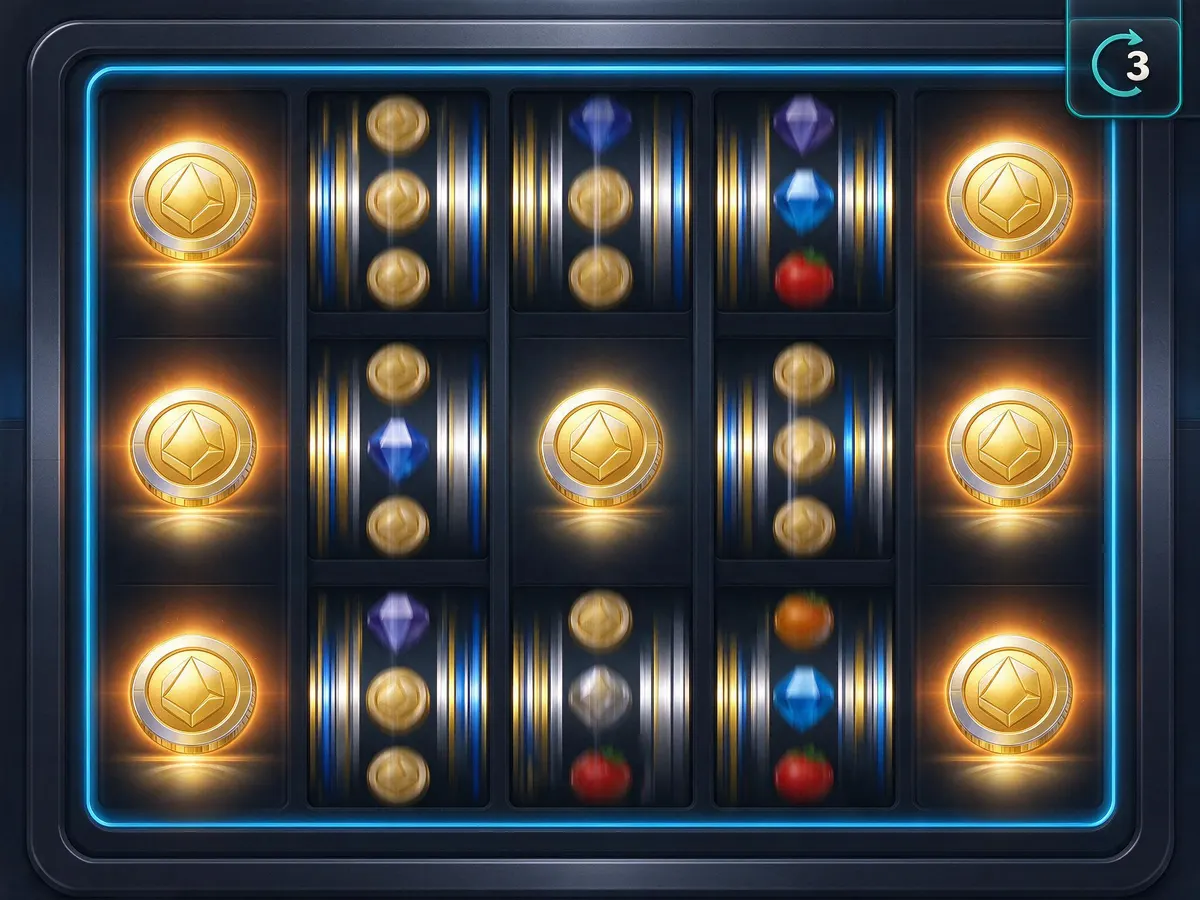
Eight cash symbols. That, according to AGS’s own product walkthrough of Roaring Express, is what it takes to unlock the game’s Roaring Jackpot. It is a very precise number attached to a feature most players describe in very vague terms, which is a decent summary of the whole situation: hold and spin is the most copied bonus round in modern slots, and almost nobody can explain how hold and spin works beyond “the symbols stick and you get more spins.”
That gap matters, because the vagueness is where the expensive misunderstanding lives. More on that further down. First, the mechanic itself.
What hold and spin actually is
Hold and spin is a bonus round in which certain symbols lock in place on the grid while the remaining empty positions get a small, fixed number of respins, and every newly locked symbol resets that counter. The round pays out the combined value of everything locked when it ends.
Hold and spin (also called hold and respin or lock and respin) is a slot feature triggered by landing a set number of cash or bonus symbols. Those symbols lock; the rest of the grid respins, usually three times. Each new lock resets the counter. The round ends when respins run out or the grid fills.
The idea came off the land-based floor, where cash-on-symbol respin bonuses performed well on cabinets, and it has since been rebuilt by nearly every studio under its own branding. The skin changes. The engine underneath rarely does.
How hold and spin works, step by step
1. The trigger
You need a minimum number of special symbols on one base-game spin, typically six, and typically the cash or bonus symbols rather than ordinary scatters. Land five of six and nothing happens, which is where the near-miss feeling comes from. Those trigger symbols carry over into the feature already locked, so you start the round with part of the grid filled.
2. The lock and the reset
Every position not occupied by a locked symbol spins again. Only two outcomes matter per respin: a new special symbol lands somewhere, or it doesn’t.
- A new symbol lands: it locks permanently, its value joins the running total, and the respin counter resets to its starting figure.
- Nothing lands: the counter drops by one.
This reset is the entire design. It is what lets a round that looked finished run for twenty more spins, and it is why the feature feels like momentum even though each respin is drawn independently.
3. How the round ends
Two ways out, and they are not equivalent. Either the counter hits zero, which is how most rounds end, or every position on the grid fills, which usually triggers a top award or jackpot tier on top of the locked values. A filled grid is the designed headline outcome and it is rare by construction. When the round closes, the locked values are totalled and paid, and you return to the base game.
The same mechanic under different names
Suppliers brand this feature heavily, which makes a handful of nearly identical rounds look like separate inventions. The differences sit in payout logic, not in the lock-and-respin core.
- Plain cash respin rounds pay the sum of locked values at the end, with fixed jackpot symbols occasionally appearing among them.
- Cash collect style features add a collector symbol: cash values sit on the grid, and a collector sweeps up some or all of them, so position and timing affect what you actually bank rather than just the total on screen.
- Link and win style features tie the locked symbols to jackpot tiers, so filling certain counts of positions unlocks mini, minor, major or grand prizes, and the full grid sits at the top of that ladder.
Practically, the first type is easy to read while the round runs, and the other two hide value behind a second condition. Neither is more generous by default.
What Roaring Express adds with repeat wins
AGS’s twist, as described in CDC Gaming’s video demo with product manager Ben Kongpipattanakarn, is that additional train symbols landing during the bonus can award previously collected prizes a second time. Standard hold and spin adds value only through new symbols; this version lets a new symbol reach back and re-pay what is already locked.
The demo covers three bonus paths in the game: a traditional hold and spin round, the Roaring Express repeat-win round, and a separate Roaring Jackpot feature, with eight collected cash symbols unlocking that jackpot. The game runs on AGS’s Glō cabinet and was shown at G2E.
Why it is worth noting: a repeat mechanic changes the shape of the round rather than just its size. In a normal round, value accumulates in a straight line. Here, a single late symbol can be worth far more than its face value, because it multiplies what came before. That makes big rounds bigger and does nothing for the many rounds that end at three dead respins. Those are two separate statements, and most coverage only makes the first one.
Hold and spin compared with other respin features
| Mechanic | What locks | What you are chasing | What it feels like |
|---|---|---|---|
| Hold and spin | Cash or bonus symbols, permanently, with a resetting counter | A full grid or a high locked total | A self-contained round that can extend itself indefinitely |
| Standard respin | Usually a single reel or a winning combination, for one respin only | One extra chance at a specific line or symbol | A short extension of the base spin, over in seconds |
| Megaways-style reels | Nothing locks; the number of symbols per reel varies each spin | A high ways count combined with matching symbols | Constantly shifting base game, no separate accumulation phase |
The difference that actually affects the session is the counter. A plain respin cannot grow. A hold and spin round can run long enough to feel like a separate game, which is exactly why players remember these features and mentally weight them more heavily than the hundreds of base spins that funded them.
The part most players get wrong: a flashier feature is not a better-paying game
Here is the claim stated far more confidently than the evidence supports, every time a new hold and spin variant launches: that an extra layer such as repeat wins means the game pays out more. It does not follow. A game’s RTP typically accounts for base-game features and bonus rounds, though progressive jackpot contributions and certain repeat-win mechanics are often calculated or disclosed separately rather than automatically folded into the stated figure. Return to player is the long-run percentage of total wagers returned, averaged over millions of rounds, and the house edge is simply the remainder.
If two games are configured to the same RTP, a more generous feature has to be paid for somewhere else in the math, usually through a colder base game, a lower trigger rate, or smaller average locked values. The money is moved, not created. What a repeat-win mechanic reliably changes is volatility: fewer, larger standout rounds and longer stretches in between.
What believing the myth costs is concrete. Players migrate to the game with the biggest feature, expect it to return more, and then burn through a bankroll built for a steadier game during the dry spells that high volatility guarantees. Same expected return, faster ruin.
Is the outcome random?
Yes. The feature is driven by the same random number generator as the base game, licensed slots are tested by independent labs before release, and each respin’s outcome is independent of the last. Being one symbol short of a full grid does not improve the chance of the next symbol landing, and no sequence of locks signals anything about what follows. There is no pattern to read and nothing to time.
Can you win a jackpot inside hold and spin? In many games, yes, and it is often the only place a jackpot can be awarded, either through jackpot symbols locking or through filling the grid or hitting a set collection count, as with the eight-symbol Roaring Jackpot in Roaring Express. Possible is not probable. Those outcomes carry the lowest hit frequency in the entire game.
Setting your limits before the grid fills
Decide the number you are willing to lose before you open the game, not during a round that keeps resetting its counter. The reset is engineered to feel like something is building, and that feeling is the most expensive thing on the screen. Treat the feature as entertainment you are paying for, because over time the house edge means that is what it is.
Deposit, loss and session limits, cool-off periods and self-exclusion are available at any licensed operator, and national gambling helplines offer free, confidential support if play stops feeling optional.
One last practical point. You can read a game’s RTP and feature description on its info screen before you commit a single spin, and on many land-based cabinets you cannot. If that information is not available to you, you are choosing to play without the one number that tells you what the game is actually set to return.