What MGM Osaka actually endorsed
MGM Osaka has put its name behind a casino dealer training course ahead of the integrated resort’s opening, according to GGRAsia. That is the fact. An endorsement means the operator considers a third-party syllabus consistent with the standard it intends to run on its own floor.
Now the complication, because this is where most readers go wrong. An endorsement is not accreditation, and it is not a job offer. There is no national croupier licence in Japan to accredit against, and no operator has yet published hiring criteria for a floor that will not open for years. If you are a prospective dealer in Kansai reading headlines about MGM Osaka casino dealers and assuming a certificate buys you a pit position in 2030, the cost of that misreading is your own time and tuition. If you are an analyst reading it as evidence that Japan now has a dealer certification regime, you are several steps ahead of the paperwork.
The specifics of the course — the provider, the length, the exact curriculum, the games taught, how students are assessed — should be checked directly against the GGRAsia report rather than assumed from how these programmes usually work elsewhere. What follows is the context around the announcement, not an expansion of its details.
One shoe of baccarat, from the dealer’s side of the table
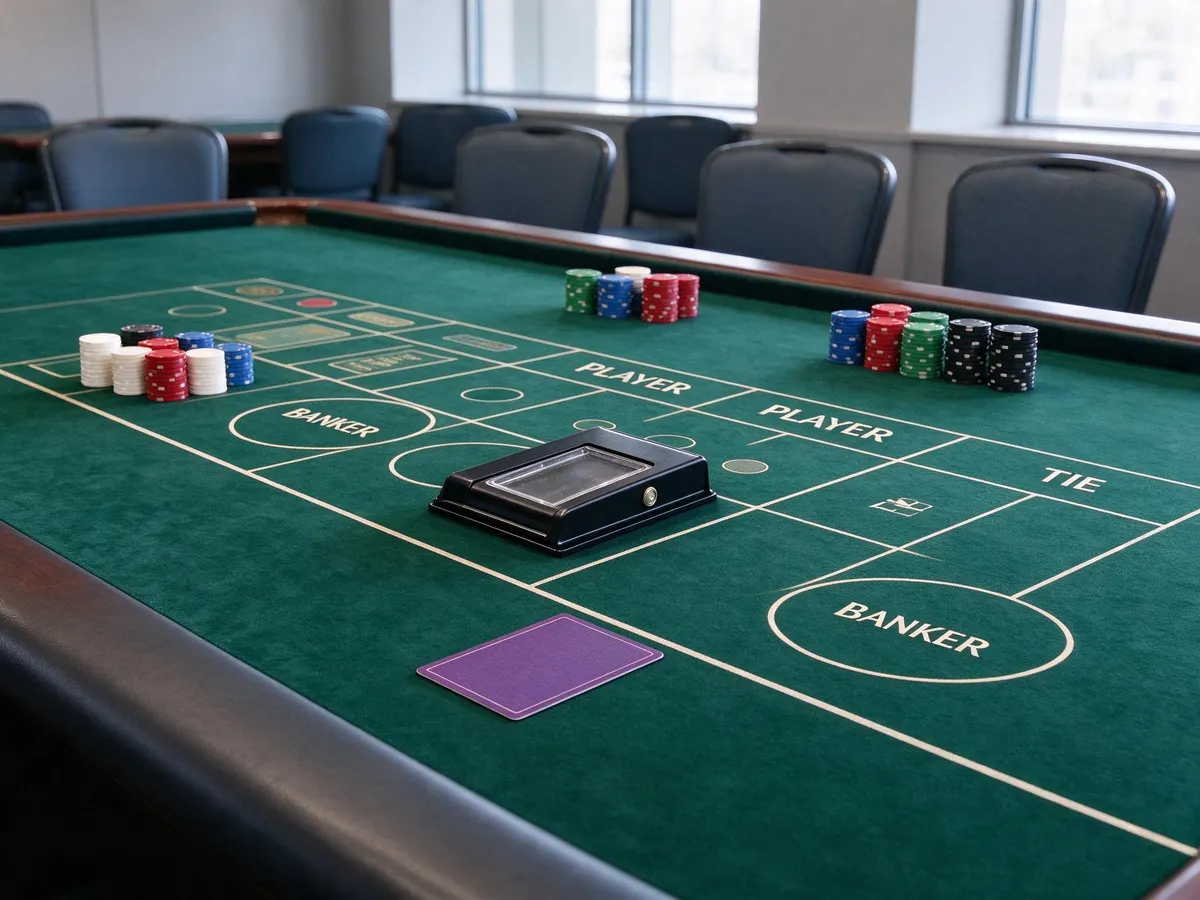
To see why a syllabus matters at all, walk through a single baccarat round as the dealer experiences it. Baccarat will almost certainly carry the Osaka floor, as it does across Asia, so this is the realistic test case.
Before a card moves, you have a shuffle and a shoe to present, a cut card to place, and a table of players watching every motion. Then bets go down across banker, player and tie. You confirm each wager is inside table limits and sitting in the right box, because a chip half on a line is an argument waiting to happen. You draw four cards, two per side, in the fixed order. You read the totals, apply the third-card rule without hesitating, and call the result out loud.
Then you pay. Player bets pay even money. Banker bets pay even money minus 5% commission, and that commission is the whole reason banker is the better bet at roughly a 1.06% house edge against about 1.24% on player. Miss the commission and you have not just made a mistake, you have inverted the economics of the game. Tie pays 8 to 1 on most layouts and carries a house edge above 14%, which is why a good dealer never nudges a player toward it.
Underneath all of that sits a second job nobody at the table sees: game protection. You are watching for late bets, for chips added after the call, for card handling by players in games that allow it, for the pattern of someone probing your procedure rather than playing it. You are also an anti-money-laundering observation point, logging buy-ins and behaviour you are required to report.
What a dealer course has to cover
Programmes of this type generally work through four blocks, and the ordering tells you what the operator values:
- Mechanical skill — shuffling, dealing, chip cutting and sizing, pitching cards, spinning and clocking a roulette wheel.
- Game procedure — the exact sequence for each game, including blackjack’s dealer rules and roulette’s payout mathematics, done at pace without a calculator.
- Customer service — in Japan’s case, hospitality conducted in Japanese for a domestic clientele that has never set foot in a legal casino, plus the language range to serve inbound visitors.
- Compliance — responsible gambling intervention, age checks, AML reporting, and the resort’s internal controls.
Which of baccarat, blackjack and roulette this particular course teaches, and whether it issues any form of certificate at the end, is detail to confirm from the source report.
Japan is building a dealer workforce from nothing
Osaka will hold Japan’s first legal casino, which in regulatory terms means something narrower than “Japan legalised gambling”. The 2018 IR Implementation Act permitted up to three integrated resort areas nationwide, each requiring a prefecture to win central government certification of its area development plan and then a licence from the national Casino Regulatory Commission. Osaka’s plan was certified in 2023, and the resort — a joint venture involving MGM Resorts International and ORIX — is being built on the Yumeshima artificial island in Osaka Bay. Public reporting has pointed to a 2030 opening, a date already pushed back once, so treat it as a target rather than a fixture.
The casino itself is deliberately small inside the project: the law caps gaming floor space at 3% of the IR’s total floor area. Japanese residents face an entry fee and strict visit caps, which is unusual among major Asian jurisdictions and shapes who the dealers will actually be serving.
Here is the staffing arithmetic that makes a pre-opening course rational. Dealers rotate off the table roughly every hour, run across three shifts, and need relief for leave and sickness, so a single table running continuously consumes several trained people. Multiply that across a floor sized for an international resort and you need a pool, not a hire. Japan has no domestic casino industry to draw that pool from. Nobody in the country has dealt a legal commercial hand of baccarat.
The trade-off with no clean answer
Every new market faces the same choice, and neither branch is comfortable. Import experienced dealers from Macau, Singapore or the Philippines and your floor is competent on day one, but you are staffing a Japanese resort with people who may not deliver service in Japanese to Japanese expectations, and you blunt the local employment case that helped sell the project politically. Train locals from zero and you get cultural fit and political goodwill, with a floor full of people whose first live shoe is also your opening night.
Endorsing an external course is a hedge on that choice. It grows the local pool before hiring starts, and it pushes the cost and the failure rate of early training outside the company. The price of that hedge is control: an operator that endorses a syllabus does not pick who enrols, does not own the assessment, and cannot guarantee that a graduate is employable. Students carry the risk. That asymmetry is worth naming plainly, and it is the part most coverage leaves out.
How online live-dealer studios handle the same problem
Online live dealer casino games face an identical quality question and solve it with different levers. Studio dealers are trained in-house by the game supplier, on a narrower set of games, under a camera that records every hand and under licensing conditions set by the jurisdiction where the studio is based.
| Dimension | Land-based IR floor | Online live studio |
|---|---|---|
| Who trains | Operator, plus external courses it endorses | The game supplier, in-house |
| Game range | Broad: baccarat, blackjack, roulette, poker variants, plus regional games | Narrower, often one or two tables per dealer |
| Oversight | Pit boss, surveillance, internal controls | Continuous recording, studio supervisor, auditable round history |
| Customer contact | Face to face, hospitality-led | Via chat, scripted and moderated |
| Error correction | Resolved at the table, sometimes with surveillance review | Round voided or corrected from video and logs |
The common thread is that player trust in a live game rests on procedure, not personality. A dealer who deals in the same rhythm every time, pays the right commission every time and never improvises is the reason a shuffled shoe feels fair. Neither channel changes the house edge, and neither should be presented as doing so.
Milestones worth tracking
Watch for four things rather than headlines. A confirmed opening date from the Osaka IR venture, not a reported target. Further training and recruitment announcements, which will reveal whether MGM intends a mostly domestic dealer workforce or a hybrid one. Any move by the Casino Regulatory Commission toward formal dealer or employee licensing standards, which would turn endorsements into accreditations. And the shape of the course pipeline itself, including whether other candidate prefectures use the same providers.
Until the commission defines what a qualified Japanese dealer is, every course in the market is doing the same thing: guessing the standard early, with an operator’s name attached as a reference point. That is useful. It is not yet a credential, and anyone spending money on one should read the terms before the brochure.
If you gamble at a resort or online, set deposit and time limits in advance and use the self-exclusion tools your operator is required to offer. The house edge is built into every game described above.