
A moving line is not a leak from the future
When a Las Vegas number shifts, the book has not learned who wins. Understanding how sports betting odds work starts with that correction: a line is a price set to balance the money coming in, and when it moves, it is telling you what the market now thinks, not what will happen at kickoff or puck drop.
The Raiders have given odds-watchers a textbook case lately. Their ground game has been averaging about 82 rushing yards per game, fifth-worst in the NFL, and in a 45-17 loss at New England they managed 38 rushing yards total, with Ashton Jeanty grinding out 27 yards on 10 carries while nursing an ankle sprain and plantar fasciitis. Over in hockey, the Golden Knights sat 5-2-0 while playing the second half of a back-to-back in Nashville. Both situations generate chatter, and chatter moves numbers. None of it is a prediction, and nothing below is a tip. This is about reading the board.
How sports betting odds work: the three numbers on every screen
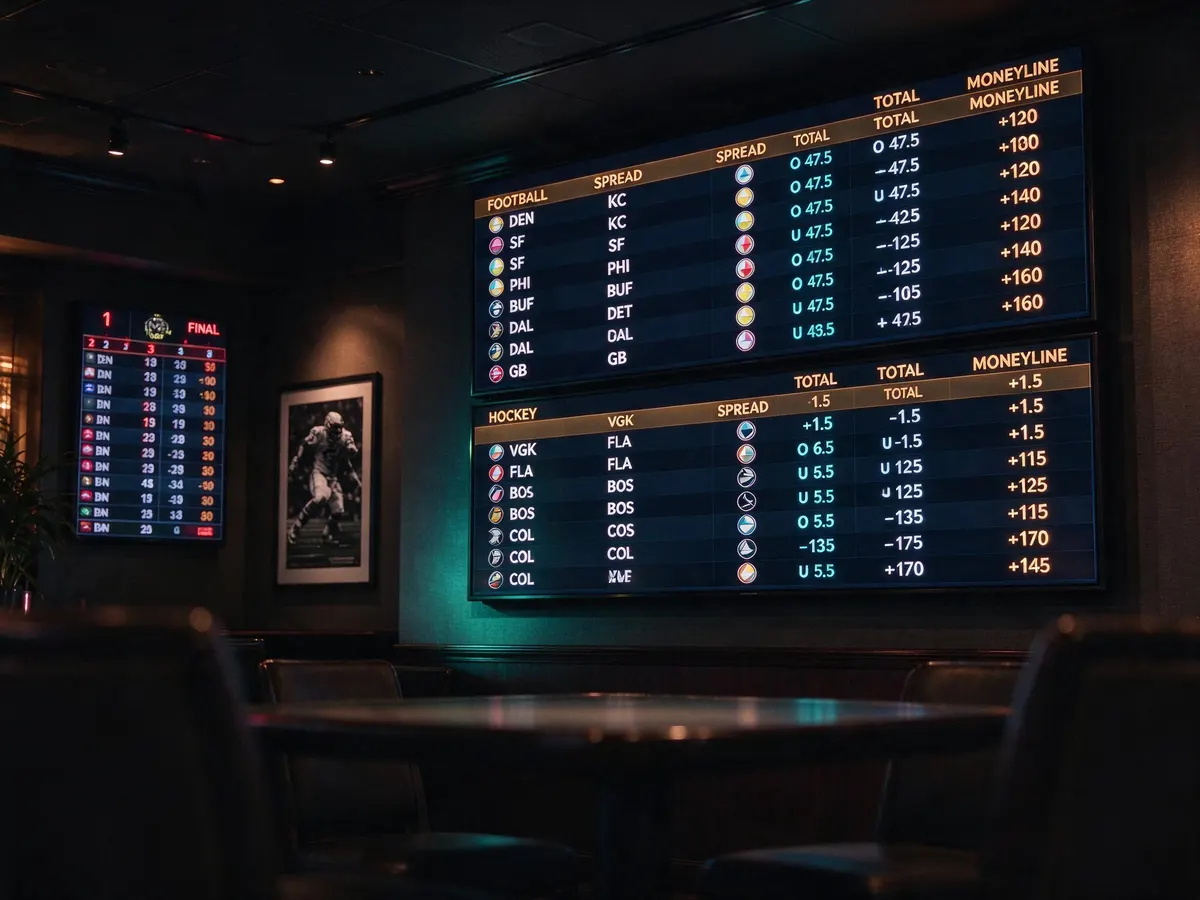
Almost every NFL or NHL game is offered as three bets: a moneyline on who wins, a spread or puck line that applies a handicap, and a total for combined scoring. Each is quoted in American odds, where a minus number is the stake needed to win 100 and a plus number is the profit on a 100 stake.
What -150 and +130 actually mean
A price of -150 means you risk 150 to win 100; +130 means 100 risked returns 130 profit. Converting to implied probability takes two formulas. For a negative price: odds ÷ (odds + 100). For a positive price: 100 ÷ (odds + 100). So -150 implies 60%, and +130 implies 43.5%.
| American odds | Implied probability | Return on a 100 stake |
|---|---|---|
| -200 | 66.7% | 150 total |
| -150 | 60.0% | 166.70 total |
| -110 | 52.4% | 190.90 total |
| +100 | 50.0% | 200 total |
| +130 | 43.5% | 230 total |
| +180 | 35.7% | 280 total |
| +250 | 28.6% | 350 total |
Add the two sides of that -150 / +130 market and you get 103.5%, not 100%. The extra 3.5 points is the vig, also called juice: the book’s margin, built into the price. On a standard -110 both ways it is 52.4% plus 52.4%, or about 4.8% of overround. That margin is the reason the house profits across thousands of settled bets regardless of who covers any single one.
The point spread, with real numbers
A spread handicaps the stronger side by a number of points. If a team is -3.5 at -110, they must win by four or more for that bet to pay; the other side at +3.5 covers if they win outright or lose by three or fewer. The half point exists to remove pushes. On a whole number like -3, a three-point win refunds both sides.
Totals, and why the number matters more than the teams
A total, or over/under, prices combined scoring by both teams. An NFL total of 44.5 pays the over if the two sides combine for 45 or more. NHL totals are far smaller, typically clustered in the five-to-seven goal range, which is why a shift of half a goal carries much more weight than half a point on a football total.
Understanding point spreads: a handicap, not a forecast
A spread is a balancing tool, not the book’s prediction of the final margin. Its job is to push betting interest toward an even split so the book collects vig from both sides rather than carrying one-way risk. If a number sat where the true expected margin was, but 80% of money landed on one team, the book would move it anyway.
This is the part beginners get backwards. A -7 does not mean the oddsmaker expects a seven-point win. It means seven points is the handicap at which roughly equal money is expected to show up on each side at -110. Those two things overlap often, because public opinion is not stupid, but they are not the same thing, and the gap between them is where most misreadings of a board begin.
Why sportsbook lines move after they open
Lines move for four reasons: new information, weather, bet volume, and the book’s own liability. Opening numbers are a first offer. Everything after is correction.
- Injury and roster news. A quarterback downgrade, a starting goaltender confirmed as the backup, or a running back labouring with an ankle sprain and plantar fasciitis all change the input. The Jeanty situation is exactly that type of factor: 291 yards on 88 carries, 3.3 yards per carry, and pass protection suffering because defences stop respecting the run.
- Weather. Mostly an NFL story. Wind above a certain threshold hits kicking and deep passing, and totals typically get marked down for it. Indoor NHL games are immune.
- Volume. Lopsided ticket counts force the price away from the popular side so the book is not exposed.
- Liability management. If one result would cost the book badly across parlays and futures too, the price reflects that risk, not an opinion about the game.
Note which of those is actually about the teams. Only the first two.
NFL spreads versus NHL betting lines
Why NFL spreads range so widely
Football scores in chunks of three and seven, and talent gaps compound over 60 minutes, so spreads stretch from a pick’em to double digits. That width is why the spread, not the moneyline, is the default NFL market. Prices on a heavy favourite’s moneyline get so short that the spread gives bettors a workable number instead.
Why hockey pairs a fixed puck line with the moneyline
NHL games are usually offered on a fixed puck line of -1.5 / +1.5, with the price moved instead of the handicap. Hockey is low-scoring and tight; a one-goal game is the norm, so there is no sensible way to stretch a handicap to five or six goals. Adjusting the odds around a fixed 1.5 does the work that a floating spread does in football. That is also why hockey bettors live on the moneyline far more than football bettors do.
| NFL | NHL | |
|---|---|---|
| Handicap | Floating spread, pick’em to double digits | Usually fixed at -1.5 / +1.5 |
| How the market adjusts | The number moves, price stays near -110 | The price moves, the number stays |
| Primary market | Point spread | Moneyline |
| Totals scale | Points, often in the 40s | Goals, usually five to seven |
Reverse line movement and steam: where the usual advice falls apart
Reverse line movement is when the price moves toward the side taking fewer bets, which usually means a smaller number of larger wagers outweighed a larger number of small ones. A steam move is a fast, broad shift across multiple books at once. Both are commonly read as the fingerprint of sharp money, and that reading is reasonable. Sharp money means professional, high-stake, price-sensitive bettors; public money means the volume of smaller recreational tickets, which is why you can see 70% of bets on one side and 60% of the money on the other.
Here is where I part company with the standard advice. “Follow the steam” treats a line move as a signal you can act on, but by the time the move is visible to you, the better price is gone. You are buying the post-move number, which is precisely the number the sharp money corrected toward. The information was in the old price. The useful version of this concept is backward-looking: closing line value, meaning whether the price you took was better than the closing price. That tells you something about your own process over a long sample. It tells you nothing about one game.
The counter-case is fair. Markets are not perfectly efficient, and a move can genuinely reveal information that has not been fully absorbed, particularly on smaller markets and early-week NFL numbers. I will grant that. What I will not grant is treating a moving number as a reason to bet. It is one data point. No price, however sharp, makes an outcome certain.
Four checks before you let a number talk you into anything
- Compare the opening line to the current line, and note the direction and size of the move.
- Check public bet percentage against money percentage. A split between them is the only way to see whose money moved the price.
- Look for the cause. An injury report, a confirmed goaltender, a forecast, a back-to-back travel spot like the Golden Knights’ trip to Nashville. If you cannot find a cause, assume liability management.
- Convert the price to implied probability and ask whether you actually disagree with it. If you do not, there is no bet to make.
And keep the vig in view. Every market is priced above 100% implied probability, so the house edge is present whether you read the board brilliantly or not. Bet only money you can lose without it mattering, set a limit before you open the app rather than after, and use the deposit and time limits every licensed sportsbook offers.
What the board will never tell you is the one thing bettors want from it: whether the move is right. The Raiders’ run-game problem is real and documented. Whether the market has already priced it correctly, overcorrected, or not caught up is unknowable until the game is played, which is exactly why reading odds is a literacy skill and not a forecasting one.


