
What a prediction market actually is
A prediction market is a venue where you buy and sell shares in the outcome of a real-world event, and the share price is the market’s implied probability that the outcome happens. Buy a contract at 62 cents and the market is saying roughly 62%: if the event resolves yes, the contract settles at $1; if it resolves no, it settles at $0.
These shares are usually called event contracts, and they are binary. Every contract has a question with a fixed resolution date and a stated source that decides the answer. Nothing about the payout is negotiable once it settles. The only thing that moves is the price in between.
Reading a contract price as a probability
Say a contract on a defined event trades at 62 cents. One hundred contracts cost $62. If the event happens, those contracts are worth $100, so the profit is $38 on $62 risked, which is the same shape as decimal odds of about 1.61. The yes side at 62 and the no side at 38 add up to a dollar, because the two sides of the same contract are the same dollar split in two.
That arithmetic is where most of the confusion starts. People hear “the price is the probability” and assume there is no cost in the way there is at a sportsbook. The price is a probability estimate, but the price you actually transact at is not the mid-point on the screen, and that difference is the whole argument of this article.
How a trade works, start to finish
A trade is five decisions, and only the last one is unique to this format.
- Pick a contract with resolution criteria you have read. Who decides the answer, from what source, and by what date. Ambiguous wording is a real risk, not a technicality.
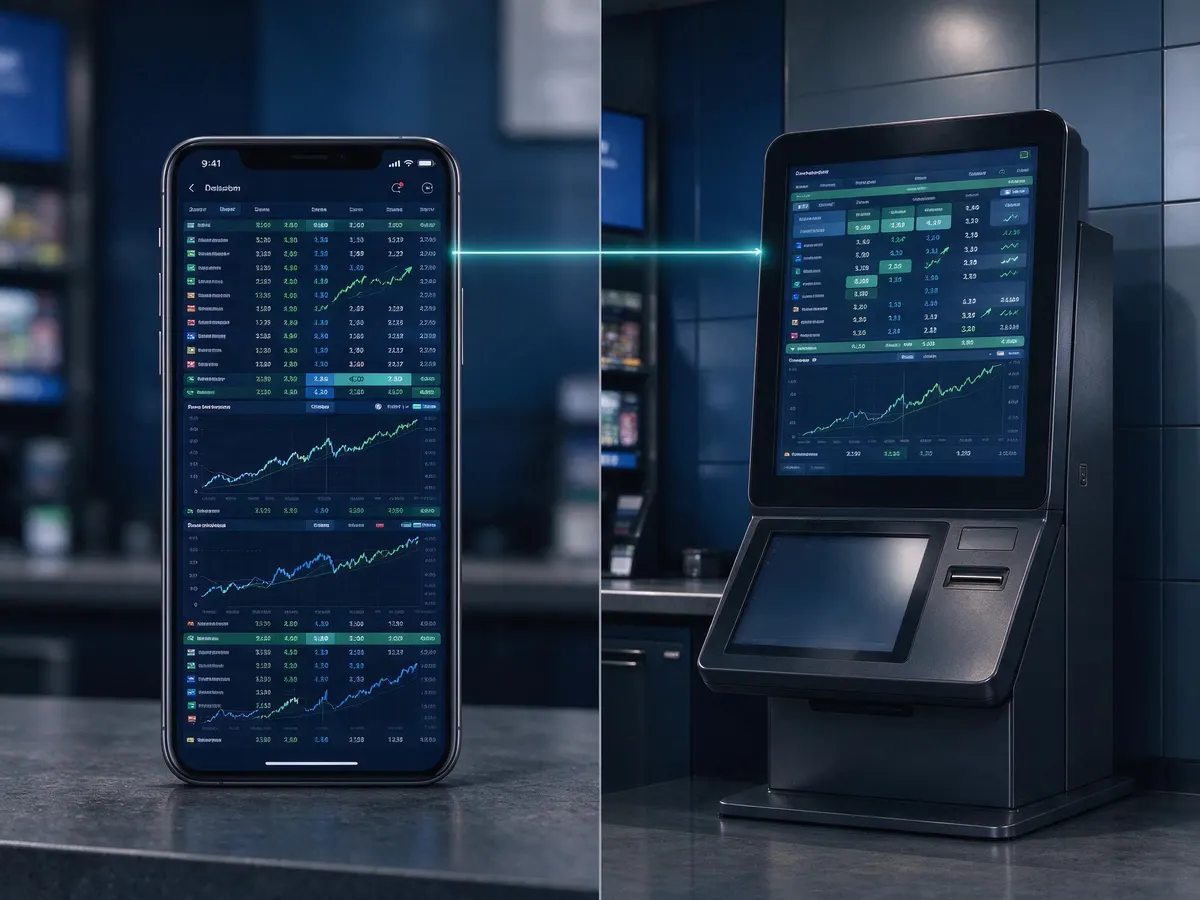
- Read the order book. The best bid is the highest price anyone is currently willing to pay; the best ask is the lowest price anyone is willing to sell at. The gap between them is the bid-ask spread.
- Buy at the ask. One hundred yes contracts at 64 cents costs $64. Your maximum loss is that $64 and your maximum return is $100.
- Hold to settlement if you want the binary result. The contract pays $1 or nothing, and the position closes itself.
- Or sell before resolution. If the price rises to 75, selling one hundred contracts into the bid returns about $75 and locks in roughly $11 regardless of what happens later. If it falls to 40, selling returns about $40 and caps the loss at $24 instead of risking the full $64.
Point five is the structural feature. A position has a running market value, so you can take a smaller loss, bank a partial profit, or change your mind when news breaks. You are not waiting on a final whistle to find out what you have.
Where sportsbooks differ, and it is not the house edge
The popular verdict that prediction markets are “not the same as sports betting” is correct, but the usual reason given for it is wrong. The real difference is not that one is free of cost. It is that the price comes from the other traders rather than from the operator, and that you can leave the position before the event finishes.
A sportsbook sets its own prices and builds a margin into them. Add up the implied probabilities on both sides of a two-way market and the total comes to more than 100%; that overround is the operator’s edge, and it is the same number whether you win or lose. Your stake is locked at the odds you took, unless the book offers a discretionary cash-out at a price it also sets.
An exchange works the other way. Traders post the bids and offers, the exchange matches them and charges fees, and it does not normally take the other side of your trade. The counterparty is another participant, often a professional market maker quoting both sides for a living. Which means the cost has moved rather than vanished: instead of a baked-in margin you pay the spread plus whatever the fee schedule says.
| Dimension | Prediction market exchange | Fixed-odds sportsbook |
|---|---|---|
| Who sets the price | Traders, through an order book | The operator’s trading team |
| Payout structure | Contract settles at $1 or $0 | Stake multiplied by the odds taken |
| Who takes the other side | Another trader or market maker | The house |
| Early exit | Sell into the book at the live price | Only if the book offers cash-out, at its price |
| Where the cost sits | Bid-ask spread plus trading or settlement fees | Margin built into the odds |
| Price after you enter | Keeps moving; your position revalues | Your odds are fixed at entry |
Why a crash multiplier is not a price
A crash game multiplier carries no information about anything. It is produced by a random number generator, often with a provably fair hash you can verify after the round, and the point at which it stops is drawn from a distribution the game designer chose with a house edge inside it. Cashing out at 2.00× doubles your stake, but nothing you could read, research or calculate changes when the round ends. Past rounds tell you nothing about the next one, which is the same reason “hot” and “cold” slots do not exist.
A prediction market price is the opposite kind of number. It moves because participants disagree about a real event and act on what they know. That makes research meaningful in a way it never is in a crash game’s cash-out mechanic, and it also makes the competition harder. In a crash game the maths is against everyone equally. In a market, you are up against people who may simply know more than you do, and the price already contains what they have acted on. Analysis helps. It does not entitle you to anything.
One shared trait is worth naming. Both formats tempt you to act fast, and in both the fast action is where the cost accumulates.
The regulation fight, and why it is genuinely unsettled
Whether an event contract is gambling or a financial derivative is being argued in court right now, and the answer depends on where you are. Operators of sports-event contracts in the United States argue they are regulated by the Commodity Futures Trading Commission and that federal commodities law exempts them from state gambling statutes. Several states disagree, have issued cease-and-desist orders, and have gone to court to keep these products out.
The friction is visible in the commercial plumbing as well. Google restricted prediction market advertising to certified, licensed providers and blocked ads aimed at residents of Connecticut, Michigan, Nevada, New York and Ohio, each of which has taken legal action against operators. Sports-event contracts are not offered in Nevada or Michigan. Underdog, after receiving a cease-and-desist letter from Tennessee, sued the state, the attorney general and the Tennessee Sports Wagering Council, arguing CFTC oversight preempts state gambling law; it has brought similar actions against Washington, Connecticut, Massachusetts, New Mexico, Ohio and Wisconsin. Before you form a view on the legal status, check the current position with the CFTC and the regulator in your own jurisdiction rather than taking an operator’s framing at face value.
In India the same classification problem shows up in a different vocabulary. Real-money gaming sits inside an unresolved argument about games of skill versus games of chance, layered with central and state rules, which leaves platforms offering event contracts to Indian users on unclear footing, and any winnings treated as gaming income carry tax consequences. Treat that as informational rather than legal or tax advice, and verify before you fund an account.
What the “no house edge” pitch leaves out
There is no operator margin baked into the odds, and there is still a cost on every round trip. Four things catch first-time users.
- The spread is the entry fee. Yes quoted 60 bid, 64 ask means buying at 64 and immediately selling at 60 loses four cents on a 64 cent position, more than 6% gone on a trade that was correct about nothing yet.
- Fees are charged separately, per trade or at settlement depending on the venue, so read the schedule before assuming a small edge survives it.
- Liquidity is uneven. Headline markets can be tight; niche contracts can be thin enough that there is no one to sell to at a sensible price, which quietly removes the early-exit feature you came for and leaves you holding to settlement.
- Resolution wording decides your payout. A contract can resolve against you on a definitional detail even when your read of the event was right.
“No house edge” is a statement about where the cost sits, not about whether you can lose. Every contract is real money at risk with a binary outcome, and the presence of informed counterparties means no amount of homework makes the result reliable. Set a figure you can afford to lose before you fund the account, use deposit and loss limits where the platform offers them, and if tracking positions starts dictating your day, use the cool-off tools. Our responsible gambling guide covers the practical limits worth setting first.
Who this format actually suits
It suits people who want to hold and manage a view on an outcome over time, and who will read a resolution clause and a fee schedule before trading. The ability to sell a position into a rising or falling price is a genuinely different tool from a locked-in bet, and it rewards patience rather than speed. If you enjoy fixed-odds markets mainly because they are quick and settle themselves, a market that asks you to decide when to leave will feel like work without much extra reward.
Two things are still open, and neither is yours to solve. The first is legal: the preemption argument is being litigated state by state, and where you can access these contracts next year is not something anyone can tell you now. The second is practical: in a thin market, the early exit that makes the format attractive may not exist when you need it. Check the depth of the order book on the specific contract you care about before you decide this is a better fit than the sportsbook you already understand.