eInstant games, explained without the trade jargon
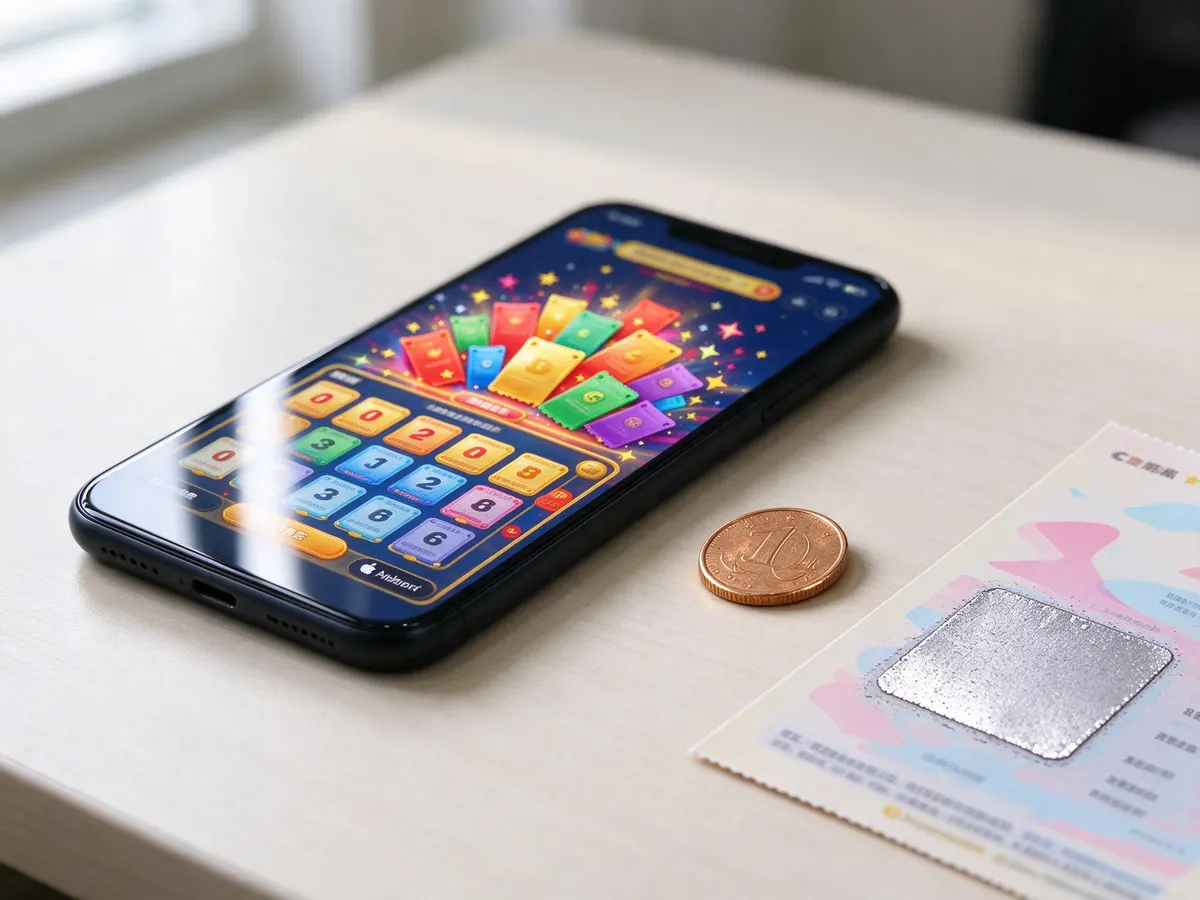
Scraping latex off a paper ticket with the edge of a coin was always the most honest part of the lottery: the result already existed before you touched it, and all you were doing was reading it. An eInstant game is that product moved onto a phone. You buy it through an official lottery’s website or app, you tap, and the game tells you immediately whether you won, with no draw to wait for.
Short definition: an eInstant is a digital instant-win lottery game sold through a licensed state or national lottery’s online channel. The outcome is settled the moment you play rather than at a scheduled draw, and the game sits under lottery regulation alongside draw-based lottery games and physical scratch cards.
Lotteries and suppliers also call this category iLottery instant content, or just “einstants”. Players usually meet it as a grid of brightly themed tiles in a lottery app: match-three games, reveal-a-prize games, and increasingly games with bonus rounds, multipliers and free-play features that look very familiar if you have ever opened a casino lobby.
The difference from a slot is drawn by the regulator, not by the reels
The reliable difference between an eInstant game and an online slot is legal, not mechanical: an eInstant is licensed, sold and overseen as a lottery product, while a slot is licensed as a casino game. Most explainers make the distinction sound sharper than it is by claiming eInstants are always finite ticket pools and slots are always pure random number generation. In practice, both models exist on both sides of the line.
Paper scratch cards work on a finite print run. A game might have ten million tickets with a predetermined number of winners, so the odds come from the structure of the pool. Some eInstants replicate that faithfully, drawing outcomes from a finite virtual pool without replacement. Others generate each result independently with an RNG, which is exactly how a slot works. You cannot tell which model you are playing from the artwork. The game’s rules page can tell you, and often does.
What does differ consistently is everything around the game.
| eInstant game | Online slot | |
|---|---|---|
| Sold by | The state or national lottery, through its own site or app | A licensed casino operator |
| Overseen by | The lottery regulator or lottery corporation itself | The casino or gaming regulator |
| Outcome model | Finite virtual prize pool or certified RNG, depending on the title | Certified RNG on every spin |
| Price point | Fixed ticket prices, often a small set of tiers | Adjustable stake per spin within a wide range |
| Where it is legal | Jurisdictions that allow online lottery sales, including several US states with no online casinos | Jurisdictions with licensed online casino gambling |
| Where proceeds go | Typically earmarked public causes, such as education funds | The commercial operator |
That last row is doing more work than the mechanics. It explains why a state can run instant-win games on a phone while prohibiting online slots outright. The category is not defined by how the maths behaves; it is defined by who is allowed to sell it.
Who actually builds the games you see in a lottery app
A lottery almost never builds its own eInstant catalogue. It licenses games from content studios and runs them on an iLottery platform supplied by a systems provider, which handles accounts, payments, state boundary checks and the integration of third-party content. Three parties, three contracts, one lobby.
The Kentucky Lottery is a current, documented example of that structure. According to a report in G3 Newswire, Aristocrat Interactive has taken games from its in-house studio, NeoGames Studio, live with the Kentucky Lottery under a five-year agreement, with the first title being The Lamp. The same report notes that Aristocrat Interactive worked with Brightstar, the Kentucky Lottery’s iLottery systems provider, on the integration, and that NeoGames Studio has produced iLottery content for more than two decades.
Where Aristocrat Interactive fits
Aristocrat is better known to most players for land-based slot brands, and NeoGames was an established iLottery supplier before it came under the Aristocrat Interactive umbrella. That combination is the interesting part of the deal. The same corporate group now supplies content to casino floors, online casinos and state lotteries, which is precisely why the eInstant category keeps drifting stylistically towards slots: a lot of it is made by people who have spent their careers making slots.
The announcement describes The Lamp as a strong performer with US players. It does not publish player numbers, revenue share, or what the five-year agreement is worth, and neither will I guess at them.
Why lotteries keep adding instant win games
Lotteries are expanding into eInstants because draw games alone no longer match how people buy anything. A draw ticket asks for patience and a second visit; an instant-win game resolves on the spot, on the device the player already has in their hand. For a lottery whose core product is a twice-weekly draw, that is a different consumption pattern, not just a different screen.
Three forces are pushing in the same direction. Lotteries in many US states and several national markets have been building out regulated online sales channels over the past decade. Players who are used to instant feedback from everything else on their phone expect it from a lottery ticket too. And lotteries, which fund public programmes from their proceeds, have a direct interest in revenue lines that do not depend on a jackpot run making the news.
The Kentucky deal is evidence of that expansion, but it is evidence of one specific kind: a lottery that already has an iLottery platform choosing to deepen its instant catalogue with external content. It is not evidence that eInstants are overtaking draw games, and the announcement makes no such claim. Anyone extrapolating a national trend from a single content agreement is reading more into it than it holds.
Certified random, but the return is harder to pin down
Regulated eInstant games are tested before launch: the RNG or virtual pool logic is certified by an independent test laboratory, the paytable is approved, and the odds of winning any prize are published in the game’s rules. That is the standard regulated lottery products are held to, and it is the same family of testing that applies to certified casino games.
Where the comparison with slots gets uncomfortable is the return figure. Online slots almost always display an RTP percentage in the game info panel. eInstants more often publish overall odds of winning and a prize table, which is useful but not the same number, and the effective return varies by price tier within the same game family. If you want the actual figure for a specific title, the only trustworthy sources are the lottery’s own game rules and odds disclosure or the relevant regulator’s published approvals. The Kentucky announcement contains no RTP figure for The Lamp, so there is no honest way to state one here.
What is certain either way: an eInstant is a real-money gambling product with a built-in house advantage, structured so that the lottery retains a share of every pound or dollar staked over the long run. The instant resolution and low ticket prices make it easy to play many rounds in a short sitting, which is the part worth watching in yourself. Use the deposit and session limits in the lottery’s own account tools, treat the spend as entertainment rather than income, and step away through the self-exclusion options if it stops feeling like either.
How to check you are buying from the real lottery
Buy eInstant games only from the official lottery’s own website or app for your jurisdiction, and verify the operator name before you deposit. Lottery brands are heavily imitated, and the games themselves are supplied by studios whose titles also appear on casino sites, so recognising a game’s artwork proves nothing about who you are handing money to.
- Start from the lottery’s official domain rather than a search ad, and confirm the site states which lottery corporation or regulator licenses it.
- Open the game’s rules or information panel and look for published odds, prize tiers and the certified paytable. A game with no disclosure is a warning.
- Expect geolocation and identity checks. Regulated iLottery sales are restricted to players physically inside the jurisdiction and over the legal age, and a site that skips those checks is not operating under the licence it may claim.
- Distinguish official sales from courier platforms, which buy physical tickets on your behalf. Those are a separate business model with separate consumer protections, and they are not permitted everywhere.
- Treat any reseller offering lottery instant games outside the official channel as unverified, regardless of how polished the site looks.
Get those checks right and the eInstant category is reasonably transparent: certified, regulated, and documented in public rules. The open question is the one the category has not resolved for itself. As lottery content and casino content converge in the same studios, players are being offered games that behave like slots under a licence written for scratch cards, and the published odds disclosure, not the label on the lobby, is the only thing that will tell you what you are actually playing.