The ESPN producer who walked away
A colleague showed Nicole Noren an ESPN interactive explainer on how to place a sports wager, built with bright cartoonish animations. “It literally made me sick to my stomach,” she told the Columbia Journalism Review. Noren, a producer at the network for 24 years and a winner of Emmy, Murrow and Peabody awards, resigned over what she described as ESPN’s pivot into gambling, and her reasons connect sports betting advertising and addiction in a way most viewers never see from the couch.
Her objection was not abstract. Noren described gambling addiction running through three generations of her family: her grandfather, her father and her brother, who died homeless on a downtown Las Vegas sidewalk at 36. “I grew up in a sportsbook,” she said, recalling being taken to Las Vegas in the 1980s and spending time in the Hilton and Caesars sportsbooks. “Addiction dictated every part of our life.”
The breaking point she named was ESPN licensing its name to the ESPN Bet app in 2023, a venture the network later wound down in favour of a partnership with DraftKings. “I was out,” she told CJR. “I’m not going to work for a gambling company and have blood on my hands.” She also said investigative pitches examining gambling addiction or scrutinising large operators stopped getting approved, and that one accountability project was “neutered” before it aired.
ESPN disputes that account. In a statement to Awful Announcing, the network said it “remains committed to journalism that serves sports fans, holds powerful interests accountable and earns our audience’s trust.” ESPN’s gambling reporter David Payne Purdum said publicly that he has covered problem gambling and industry scandals with support from senior editors. Noren now works as an independent filmmaker on an initiative with journalists, nonprofits and public-health groups aimed at educating young audiences about gambling addiction.
Which part of that you find convincing is a judgement call about one newsroom. The more useful question for anyone watching four hours of football a weekend is what the ad load itself does.
Why betting ads are suddenly inescapable
The volume traces back to the 2018 US Supreme Court decision that struck down the federal sports betting ban, after which legalisation moved state by state and operators began competing for the same finite pool of customers. Customer acquisition is the main cost in that fight, and sports broadcasts are where the customers already are.
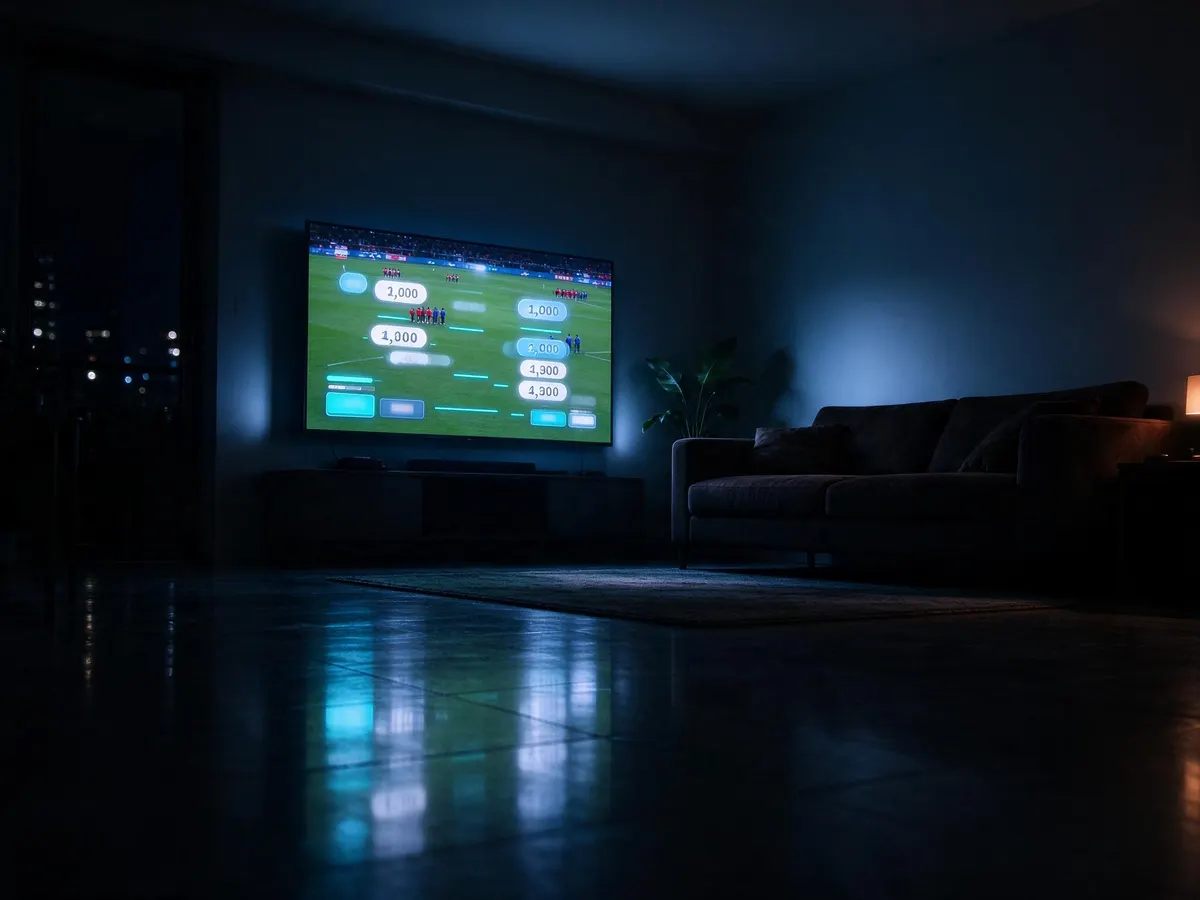
ESPN itself kept gambling at arm’s length for years after the ruling before reversing course. What grew in the meantime was not only commercial breaks. Odds now appear as on-screen graphics during live play, studio segments discuss spreads as a matter of course, sportsbooks hold official-partner status with leagues and teams, and apps push in-game prompts to your phone while the broadcast runs on the television in front of you. A single game can carry sponsored odds, an ad break, a studio pick and a push notification offering a boosted price on the next drive.
That is the shift worth naming plainly: betting stopped being something you went out to do and became part of the texture of watching the sport.
How constant exposure changes gambling addiction risks
Repeated advertising exposure is treated as a risk factor for problem gambling, not a cause of it, and the distinction matters. Bodies including the National Council on Problem Gambling and public-health researchers have flagged marketing saturation as a concern, particularly for young people and for people already in recovery. What the research supports is association and plausible mechanism. It does not give you a clean figure for how many ads push how many people over a line, and anyone quoting one should be asked where it came from.
Repetition makes a thing ordinary
The mechanism is familiarity. When a behaviour appears constantly in a trusted setting, presented by broadcasters you have watched for years, it reads as normal rather than as a financial risk being sold to you. Frequent exposure also makes betting the first idea available when a game gets dull or a result goes against you, which is the availability effect doing its work. The prompt arrives at the exact moment a bored or frustrated viewer is most receptive.
Noren’s reaction to the cartoon-animated explainer sits here. Her complaint was not that the content was false. It was the register: instruction for an audience that includes people who have never considered the downside.
The headline number and the line underneath it
Promotional offers escalate play because the advertised figure and the term that qualifies it are rarely the same size. A sign-up offer stated as a large dollar amount in “bonus bets” is not a cash balance. With most bonus bets the stake is not returned when the bet wins, so a $100 bonus bet at even money returns the $100 profit, not $200. Casino-side offers carry wagering requirements instead, where the bonus must be turned over a set number of times before anything can be withdrawn.
Neither term is hidden. Both are in the small print, and both change what the headline number is worth. The practical effect of a promotion is that it gets a bet placed that would not otherwise have been placed, and the second bet after it is at normal prices. Those prices carry a built-in margin: standard two-way pricing at -110 on both sides implies a book holding roughly 4.5% of money staked over time. That edge, not the promotion, is what the business runs on.
As for how much advertising is too much, there is no researched threshold to quote, and claiming one would be invention. The measurable version is personal. If ads are prompting bets you had not planned, the volume reaching you is already doing something.
Red flags worth taking seriously
The signs below are the ones clinicians and helplines consistently describe, and most of them appear well before money runs out:
- Chasing losses with larger stakes to get back to even
- Betting money set aside for rent, bills or food
- Borrowing to fund bets, or selling things to cover them
- Hiding the scale of activity from a partner, family or friends
- Feeling irritable, flat or restless on days without a bet
- Being unable to watch a game without having money on it
- Betting longer or more often than intended, repeatedly
- Lying about wins, or counting a promotion as a win
One of these on its own may mean nothing. Three or four together, over weeks, is the pattern worth acting on.
Tools that exist, and what each one actually does
Every licensed operator in a regulated market is required to offer account controls, and they work because they bind your future self, not your current mood. Set them when you are calm, not after a bad Sunday.
| Tool | What it does | Where to set it |
|---|---|---|
| Deposit limit | Caps money added per day, week or month; increases usually take effect only after a delay | Account settings with each operator |
| Loss limit | Caps net losses over a period, which deposit limits alone do not | Account settings with each operator |
| Time-out or cool-off | Locks the account for a short fixed period, typically days to weeks | Account settings with each operator |
| Self-exclusion | Blocks access for months or years, often across all operators in a jurisdiction | State or national schemes; GAMSTOP covers licensed sites in Great Britain |
| Reality checks | Interrupts play with reminders of time and money spent in the session | Account settings with each operator |
Support exists outside the apps too. In the United States, the National Problem Gambling Helpline, operated by the National Council on Problem Gambling, runs on 1-800-522-4700 (also reachable as 1-800-MY-RESET, or by text on 1-800-697-3738), available 24/7 and free, and the National Council on Problem Gambling lists state-level treatment and self-exclusion programmes. In the UK, the National Gambling Helpline is operated by GamCare on 0808 8020 133. Gamblers Anonymous runs peer meetings in many countries. Helplines also take calls from family members, which is often how these conversations start.
What the tools cannot do is remove the advertising. Account limits stop deposits; they do not stop the odds graphic on the screen or the push notification at half-time. Turning off marketing emails and app notifications, and muting the accounts that feed you picks, is the part most people skip.
What one resignation shows about who pays for the broadcast
Noren’s account and ESPN’s rebuttal cannot both be fully right about what happened inside that newsroom, and this article is not the place that gets settled. The structural fact underneath the dispute is not in dispute at all: sports media companies now take revenue from the same industry their journalists are expected to scrutinise, and viewers are watching through advertising paid for by the losses of other viewers.
That arrangement is legal, disclosed and unlikely to shrink. Whether it should exist is a policy argument other people are having. The narrower question a bettor can actually answer is whether the volume of prompts reaching them is changing what they do, and the honest way to check is to look at a month of transaction history rather than at a feeling about it. If that history shows bets that only exist because an offer arrived, the limits and the notification settings are both sitting there, unused.
If gambling has stopped being entertainment and started being a problem, contact a national helpline such as the National Problem Gambling Helpline on 1-800-522-4700 in the US or 0808 8020 133 in the UK. Support is free and confidential, and gambling is for adults only.