
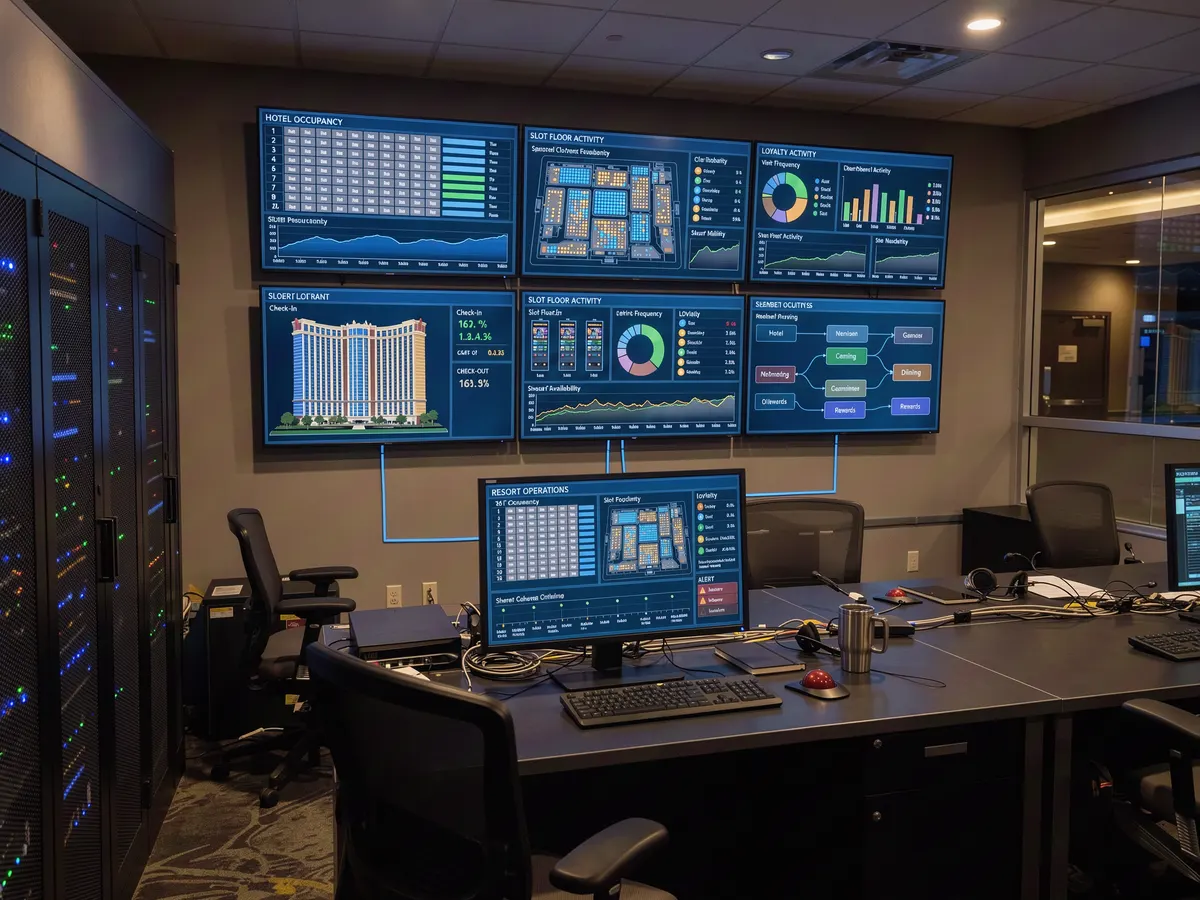
How many separate pieces of software does it take to check a guest into a casino hotel, credit the play they put through a slot machine the night before, and hand them a comped breakfast without an argument at the desk? At a lot of properties, the honest answer is four or five, none of which talk to each other in real time. A casino operations platform is a single software layer that runs booking, loyalty, gaming and back-office functions off one shared data model instead of a patchwork of vendor systems stitched together by nightly file transfers.
The current example sits in Canyonville, Oregon. According to an announcement from Quick Custom Intelligence carried by G3 Newswire in October 2026, Seven Feathers Casino Resort has selected QCI Resorts, described by the vendor as “The Unified Operating Layer for Integrated Resorts,” to bring the entire property onto one connected platform. It is one deal, not a trend on its own. But it is a clean illustration of what a growing number of operators are deciding to do about the mess behind the front desk.
What a unified casino operations platform actually merges
A unified resort management software stack combines the functions that used to be bought separately: the property management system for rooms, the booking engine, loyalty and CRM, the casino management system that tracks slot and table play, point of sale for food and beverage, and the reporting layer sitting over all of it. One database, one guest record, one set of numbers.
Booking and property management
The PMS holds reservations, room inventory, rates, housekeeping status and folio charges. In a siloed setup it knows a guest is in room 412 and owes $380. It does not know that the same person is a high-frequency slot player whose room should have been comped on arrival.
Loyalty and CRM
Loyalty tracks tier status, points, offers and redemption history. This is usually the system that gets blamed when a guest is told their points “haven’t posted yet.” Points that post on a batch schedule rather than continuously are a symptom of two databases agreeing only once a day.
Gaming, table and slot management
The casino management system handles player tracking at the machine and the table: carded play, theoretical win, average bet, time on device. It is the richest source of guest value data in the building, and historically the most isolated from everything else.
What the Seven Feathers announcement actually said
Per the QCI announcement reported by G3 Newswire, the expanded partnership extends QCI’s role beyond gaming analytics into the systems that run the wider resort, with hotel, food and beverage, the RV resort, fuel and finance operations brought into scope. The release describes Seven Feathers as replacing legacy systems with an integrated platform built around a shared data model, so teams across the resort work from the same information and coordinate across departments. The announcement also names Seven Feathers as a development partner helping shape the vendor’s future unified resort product.
Worth reading that last part carefully. A development partnership means the property is co-building, not buying something finished off a shelf. That is a different risk profile from a standard implementation, with more influence over the roadmap and more exposure to its delays. The release does not state a timeline, a contract value or a go-live date, and nothing here should be read as a verified account of how the rollout performs in practice.
The siloed stack, and where it actually leaks
A legacy casino backend typically looks like this: a PMS from one vendor, a booking engine from a second, a loyalty database from a third, a slot and table management system from a fourth, F&B point of sale from a fifth, and a data warehouse that ingests extracts from all of them overnight. Integration exists, but it is usually a set of scheduled file transfers and middleware that someone configured years ago and nobody wants to touch.
| Function | Siloed stack | Unified platform |
|---|---|---|
| Guest record | One per system, reconciled on a schedule | Single record across all modules |
| Loyalty points | Often posted in batches | Updated against live play data |
| Comp decisions | Host checks two or three screens | Visible at the point of service |
| Reporting | Warehouse built from nightly extracts | Queried from one data model |
| Vendor relationships | Many, each with its own contract and support line | One, with one support line |
The cost of silos is rarely a dramatic failure. It is friction, paid in small amounts, constantly. A host cannot see a guest’s full value without opening three applications. Marketing builds a campaign from data that was accurate at 2am. Finance spends the first week of each month reconciling numbers that disagree because two systems define “visit” differently. Integration work is quoted per connection, so adding a sixth system means building five new interfaces, not one. None of that shows up as a line item called “data silos,” which is exactly why it survives so long.
Why the consolidation push is landing now
Three forces are doing most of the work. Cloud delivery made it practical to run core property systems off-premise, which removed the hardware argument that kept legacy stacks in place. Guest expectations moved: people who book a hotel room on their phone expect their player tier to be recognised in the same transaction, and a batch-updated loyalty balance reads as broken. And analytics demand changed shape, from monthly reporting to decisions made on the floor during a shift, which a nightly extract cannot support.
There is also a quieter driver. Maintaining five vendor relationships means five contracts, five upgrade cycles, five support escalation paths, and a specialist on staff for each. For mid-size properties, that overhead is disproportionate to the size of the operation. Consolidation is partly an answer to a staffing problem.
What operators gain, and what guests notice
The operational benefits of a unified gaming platform are concrete rather than visionary. A single guest and player view, so a host or front-desk agent sees room history, spend and carded play in one place. Loyalty balances that reconcile against live gaming data rather than a nightly job. Fewer handoffs between departments, because the room, the restaurant and the floor are reading the same record. Consolidated reporting and cross-property analytics built on one definition of each metric, which removes a recurring argument about whose number is right.
Guests experience almost none of this directly. What they notice is the absence of friction: points that appear when expected, offers that match what they actually play, a check-in that does not require re-explaining who they are. It is invisible when it works, which makes it a hard investment to justify and an easy one to notice when it fails.
The bill that comes with consolidation
Vendor lock-in is the obvious one, and it is real. When booking, loyalty, gaming and finance all live in one platform, the exit cost is not switching a module, it is replacing the operating layer of the business. That changes the negotiating position at every renewal, permanently. Operators who have been through a single-vendor relationship that soured tend to be the most sceptical voices in these discussions, and they are not wrong.
Migration is the second. Replacing legacy systems at a property that does not close means cutting over live, with historical player data, point balances and folio records that must land intact. A loyalty balance that migrates wrong is a dispute with a guest at the desk, repeated a few hundred times. There is no version of this that is low risk.
The third is concentration. Silos are inefficient, but they fail independently. When one platform runs hotel check-in, the slot floor interface and the loyalty ledger, an outage or a security incident reaches all three at once. The resilience question stops being “is the vendor good” and becomes “what do we do for the hours it is down,” which is a question most operators answer less thoroughly than they should.
Which reading is right
There are two defensible positions. One says keep best-of-breed systems and invest in genuinely modern APIs between them, preserving the ability to replace any single component. For large multi-property groups with the internal engineering to run that integration layer properly, that argument holds up well. The other says the integration layer is the hard part and most operators are not good at it, so buy it from someone whose business depends on getting it right.
For a single-property resort of the Seven Feathers type, hotel plus gaming plus F&B plus an RV park plus fuel, the second position wins. The reconciliation burden across that many functions is too high to carry with middleware and a small IT team, and the guest-facing cost of getting it wrong is visible every day. The lock-in is a genuine price, not an imaginary one. It is simply the cheaper of the two prices.
What the industry has not yet settled is whether the shared data model survives the vendor. Consolidation is sold as unification, but it is also standardisation on one supplier’s definition of a guest, a visit and a trip. The operators who come out of this well will be the ones who insisted, in the contract, on owning their data in a form that outlives the platform. That clause is less exciting than the demo, and more likely to matter in five years.