A slot advertised at 96% RTP returns roughly ₹96 for every ₹100 wagered, averaged across millions of spins by thousands of players. Not across your Tuesday evening. Now add fog, an organ sting and a pumpkin scatter: that 96% does not move a single decimal place. Halloween slot games are a seasonal coat of paint on mathematics that was decided long before anyone drew the bats.
That is the whole literacy problem in one sentence, and it is worth walking through properly, because every October the lobbies fill up with new rows of orange thumbnails and most players judge them on the thumbnail.
What you are actually looking at when a Halloween collection drops
A seasonal slot release is a game whose theme, artwork, symbols and audio are built around a holiday, launched to coincide with that holiday’s marketing window. CT Interactive, for example, announced a dedicated Halloween collection pulling together dark fantasy and seasonal titles including TransilWinia, Bloody Princess, Halloween Hot and Dark Woods, offered to operators as a packaged lineup for the season.
Note the word “collection”. That is the thing to understand first. A collection is usually a curated grouping of titles, some new, some already in the catalogue, bundled so operators can run a seasonal lobby. It is a merchandising unit, not a technical one. Within any such group you may find a brand new game engine, a long-standing title that has been in the portfolio for years, and a reskin of an existing math model wearing new symbols. The lobby row looks identical in all three cases.
A reskin, in the narrow sense, keeps the reel structure, paytable logic, hit frequency and RTP of the original game and swaps the art, sound and symbol names. A genuinely new seasonal title has its own math model, its own feature set, its own volatility profile. Both are legitimate. Neither is disclosed on the tile.
Why providers time these releases to October
The logic is engagement calendars. Halloween has an unusually strong visual identity, which is exactly the point CT Interactive’s marketing chief made when the collection was announced: the imagery lends itself to themed promotions. Operators want a reason to send a campaign, refresh the front page and run a tournament; a seasonal lineup gives them one without any product development on their side.
Seasonal slot releases also solve a shelf-life problem. Slot catalogues are enormous and attention concentrates on whatever sits in the “new” row. Repackaging content around a date is a cheap way to move older titles back into view. That is not sinister, it is scheduling. But it does mean “new for Halloween” and “new” are different claims, and only one of them tells you anything about the game.
The part the campaign never mentions: RTP and volatility
Theme changes what a slot looks and sounds like. Slot RTP and volatility determine what it does to your balance. These are separate layers, and seasonal marketing only touches the first.
RTP in plain numbers, and where the real figure lives
RTP is the share of total wagers a game returns to players over the long run. House edge is the remainder: a 96% RTP game carries a 4% house edge, a 94% game carries 6%. Most online slots sit somewhere around 94% to 97%. On ₹100 of wagering, the gap between those two ends is ₹3 in expectation, which sounds trivial until you remember that wagering compounds. Spin ₹20 a hundred times and you have wagered ₹2,000, not ₹20.
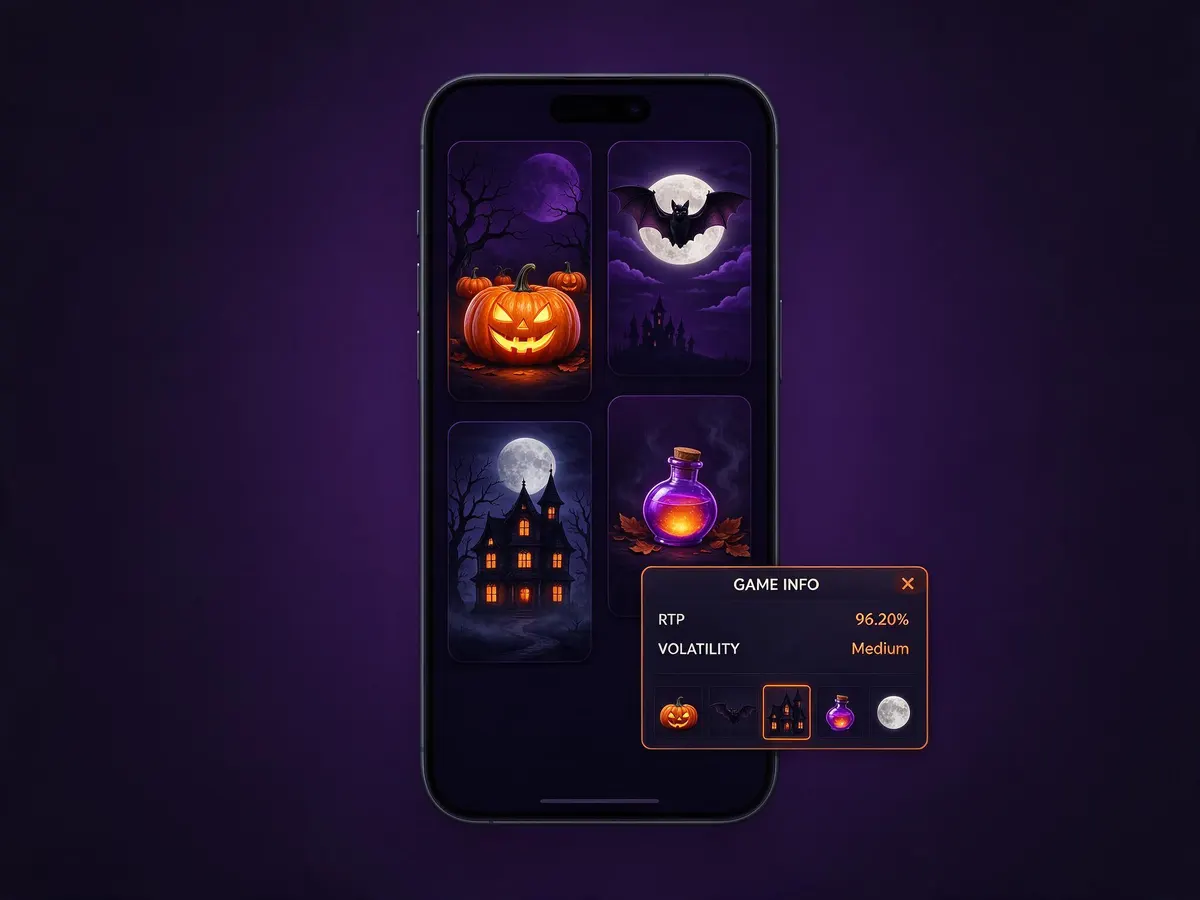
The figure that counts is the one in the game’s own information panel, the paytable or rules screen you reach from inside the game. Some providers supply more than one RTP configuration of the same title, and the operator chooses which to run, so a number quoted on a third-party review page can be out of date or simply not the version you are playing. Check it in the game, on the site you are playing on.
Volatility, and why two 96% slots feel nothing alike
Volatility describes how a game’s returns are distributed, not how large they are in total. Two slots can share an identical 96% RTP and deliver completely different sessions: one drips small wins constantly, the other pays almost nothing for two hundred spins and then resolves in a single bonus round. Hit frequency is a related but separate measure, covering how often any win lands regardless of size.
| Volatility | Win size | Win frequency | Typical session shape |
|---|---|---|---|
| Low | Small | Frequent | Balance drifts slowly, few big swings |
| Medium | Mixed | Moderate | Mild peaks and troughs |
| High | Large but rare | Infrequent | Long dry stretches broken by occasional spikes |
Neither profile is better. High volatility means a bankroll can empty faster than the RTP figure suggests it “should”, because the long run the RTP describes is far longer than any session you will play. Low volatility feels safer and still grinds down against the house edge, just more quietly. The choice is about what kind of session you want, not about which game pays more.
Where the evidence runs out
Here is the honest limit. Launch announcements for seasonal collections typically publish titles, themes and executive comment. They do not publish RTP ranges, volatility ratings or max win multipliers, and the announcement behind this year’s Halloween collection is no exception. So I cannot tell you the RTP or volatility of TransilWinia, Bloody Princess, Halloween Hot or Dark Woods, and I am not going to estimate them. Those figures exist in the provider’s official disclosures and in each game’s info panel. That is where to get them.
There is a real trade-off underneath this, and it has no clean answer. A reskin of a proven math model is, in one sense, the known quantity: the engine has been live for years, its behaviour is documented, its RTP is established. A brand new seasonal title may have more interesting features but no track record you can look up. Yet the reskin is also the one being sold to you as new, which is the mild deception in the whole exercise. You can prefer either. What you cannot do is tell which is which from the lobby, and the industry has little incentive to make that distinction visible.
Six checks before you spin any new release
- Open the game’s info panel and read the stated RTP. If no figure is disclosed anywhere, treat that as the answer and move on.
- Find the volatility rating, usually in the same panel or on the provider’s game sheet, and decide whether that swing profile suits your budget.
- Confirm the provider and the operator’s licence. Known studios publish game sheets; unlicensed sites publish nothing you can verify.
- Play the demo first. Free play uses the same RNG and reveals the feature pace, the bonus trigger rhythm and whether you actually enjoy it, at zero cost.
- Read the terms on any seasonal bonus attached to the launch, specifically the wagering requirement, game weighting, max bet while the bonus is active and max cashout. A 30x requirement on a ₹1,000 bonus means ₹30,000 of wagering before withdrawal.
- Set the deposit and session limits before the first spin, not after a bad run.
Halloween, Christmas, and the rest of the calendar
The same cycle repeats all year. Christmas and New Year collections arrive in December, Lunar New Year content in late winter, Diwali and festival-timed releases for Indian-facing operators in autumn, with Easter, summer and football tournaments filling the gaps. Themed online slots are a permanent production line, and once you recognise the pattern, each drop stops feeling like an event and starts feeling like what it is: a restocked shelf.
That recognition is the useful part. Evaluate the October lineup with the same four questions you would use in March, because the theme carries no information about the game.
Playing the novelty without letting it set your stake
Nothing about a seasonal release improves your odds. The house edge is built into every slot in the collection, hype or no hype, and no RTP figure is a promise about your session. The specific risk with a heavily marketed launch is stake inflation: a new game, a tournament leaderboard and a deposit offer in the same email nudge people to bet larger than usual on a title whose behaviour they have never seen.
Keep the stake you would use on any other game. Set a time limit alongside the money limit, because novelty stretches sessions. Use the deposit caps, loss limits and cool-off tools your operator provides, and if a session stops being entertainment, stop it. The minimum gambling age varies by jurisdiction and game type, commonly 18 or 21 depending on the state or country and on whether the gambling is online or land-based, so check the rule that applies where you are. Gambling should be budgeted as the cost of an evening, never as a way to make money. Free, confidential support is available through services such as GambleAware.
The fog machine is doing its job. Read the info panel anyway.