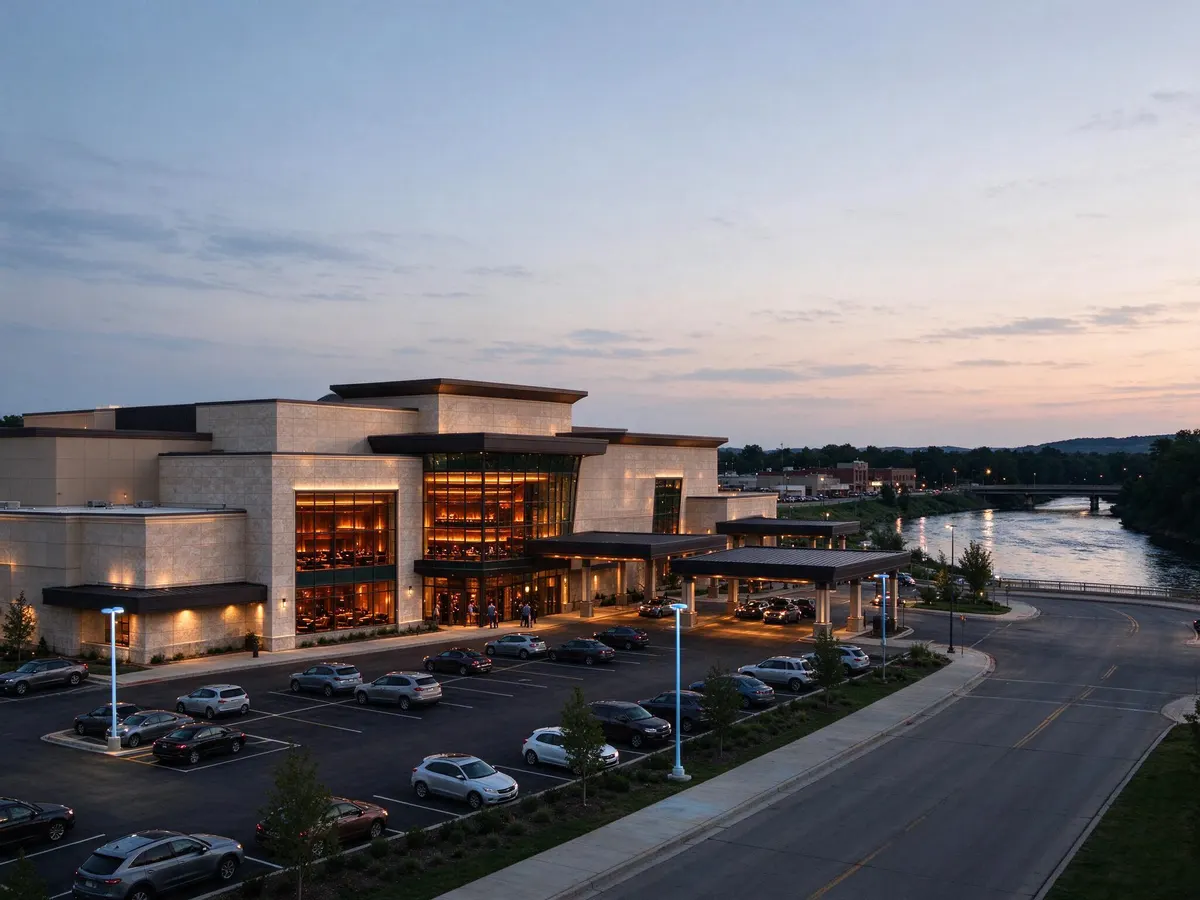
Cedar Crossing Casino’s opening date, confirmed
Cedar Crossing Casino & Entertainment Center opens with a soft launch on Thursday, November 19, 2026, in Cedar Rapids, Iowa, as a $275 million build from Los Angeles-based Peninsula Pacific Entertainment (P2E). Casino.org reports that construction finished ahead of the original New Year’s Eve target, with table games being delivered and interiors finished in the weeks before the doors open, a week ahead of Thanksgiving and Black Friday.
One number in the paperwork is more interesting than the opening date. The casino has committed 8% of its annual gross gaming revenue to local charitable causes, against a 3% state mandate in Iowa. That is projected to push more than $6 million a year through the Linn County Gaming Association. For a regional property of this size, that is not a rounding error. It is a structural cost, and it tells you what a competitive Iowa licence now costs in commitments rather than concrete.
Project snapshot
- Location: Cedar Rapids, Linn County, Iowa
- Cost: $275 million
- Developer and operator: Peninsula Pacific Entertainment (P2E)
- Soft opening: Thursday, November 19, 2026
- Gaming floor: roughly 700 slot machines, 22 live dealer table games, a retail sportsbook
- Dining: five planned bar and restaurant concepts, including Clubhouse by Zach Johnson, a steakhouse fronted by the Iowa-born professional golfer
- Entertainment: The Event Center, a 1,500-seat concert venue with dates already announced for Old Dominion, Trace Adkins, Carlos Mencia, Carrot Top and Tyler Henry
- Non-gaming: the Compass Center, a 5,000 sq ft STEM lab with its own entrance, opening with the interactive “Astronaut” exhibition running through February 2027, presented by Cedar Rapids Bank & Trust. Ticket pricing: not yet disclosed
- Community commitment: 8% of annual GGR to charity via the Linn County Gaming Association, versus Iowa’s 3% requirement
Why Cedar Rapids, and why it took this long
Iowa licenses commercial casinos through the Iowa Racing and Gaming Commission, and Linn County spent years trying to get one. General manager Kim Pang appeared before the commission on Thursday, October 15, ahead of the opening, describing the project as something “Cedar Rapids has been waiting for this for many years.” The phrasing is promotional, but the history behind it is real: a county-level licence in a mature gaming state is a contested asset, not a formality.
That context explains the 8% charitable pledge and the STEM lab more honestly than any press release does. When a licence is awarded at the discretion of a state commission weighing local benefit, the winning bid tends to carry visible community obligations. A children’s science centre with a separate entrance so families can bypass the gaming floor is a sensible piece of design. It is also, plainly, a licensing argument built in brick.
What a $275 million build says about US casino investment
The more revealing part of the story is where the money came from. In 2022, P2E sold the bulk of its gaming portfolio to Churchill Downs Inc. in a $2.75 billion deal covering Colonial Downs racetrack in Virginia, six Rosie’s Gaming Emporium venues, The Rose Gaming Resort in Dumfries, del Lago Resort & Casino in New York and the Hard Rock Hotel & Casino in Sioux City. P2E then rebuilt around new assets: Cedar Crossing, Kansas Crossing Casino in Pittsburg, Kansas, and four Revo-branded properties in New Hampshire.
So this is recycled casino capital going straight back into regional land-based gaming, in markets with no legal online casino. That is a deliberate bet by people who had the option to cash out and stay out. It is a single data point, and I would not stretch it into a national trend on its own. Readers who want the actual shape of US commercial gaming investment and revenue should go to the American Gaming Association, which publishes commercial gaming revenue tracking by state and by vertical. Those figures are updated regularly, and quoting a stale number is worse than quoting none.
Land-based growth versus online casino growth
Both channels are growing in the US, and the common framing that online is draining brick-and-mortar is asserted far more confidently than the available evidence supports. The main reason is simple: legal online casino gaming exists in only a handful of states, so there is very little overlapping data to test the claim against.
Where online casino growth is outpacing brick-and-mortar
Legal iGaming is live in roughly seven states, among them New Jersey, Pennsylvania, Michigan, West Virginia, Connecticut, Delaware and Rhode Island. In those markets, online casino revenue has climbed quickly, which is what you expect from a young vertical on a small base with 24-hour access and no travel cost. Fast percentage growth from a standing start is not the same as a structural shift in the national market, and treating it as such is the single most common error in coverage of this topic.
Where land-based investment still leads
Land-based casinos still account for the large majority of US commercial gaming revenue and nearly all of the sector’s physical employment, construction spend and local tax base. Cedar Crossing is a straightforward example: a retail sportsbook, 700 slots, 22 tables, a concert hall and five food and beverage outlets cannot be replicated by an app, and in Iowa there is no legal online casino competing for the same wallet anyway.
| Dimension | Land-based casino | Legal online casino |
|---|---|---|
| Legal availability | Commercial or tribal gaming in most states | About seven states |
| Capital required | High, fixed, site-specific ($275M here) | Low fixed cost, high marketing spend |
| Local economic footprint | Construction, permanent jobs, tourism, local tax | State tax receipts, limited local employment |
| Growth pattern | Market-by-market, slow, licence-gated | Faster percentage growth from a smaller base |
| Player access | Travel required, opening hours | Continuous, in-state geolocation only |
The claim worth being sceptical about
The projected $6 million a year in charitable distributions is a distribution figure, not a measure of wealth created. How much of it is new money depends on how much play comes from outside Linn County rather than from discretionary spending that would otherwise have gone to local restaurants, bars and retail. That split has not been published, and until it is, the economic impact case for any regional casino should be read as partly recapture and partly redistribution. The jobs and the construction spend are real. The claim that the whole figure is additive is not supported yet.
What to take from one casino opening
If you follow the US market, read Cedar Crossing as evidence that a specific regional supply gap has finally been filled, and that serious operators still see returns in physical venues in states without legal iGaming. Do not read it as a verdict in the online-versus-land-based argument, because the states building casinos and the states licensing online casinos barely overlap. Online access keeps expanding in parallel, state by state, and that expansion is what actually changes how most people gamble. Wherever you play, the house holds a mathematical edge in every game on either side of that divide, which is why deposit limits and session reminders are worth setting before you need them rather than after.