
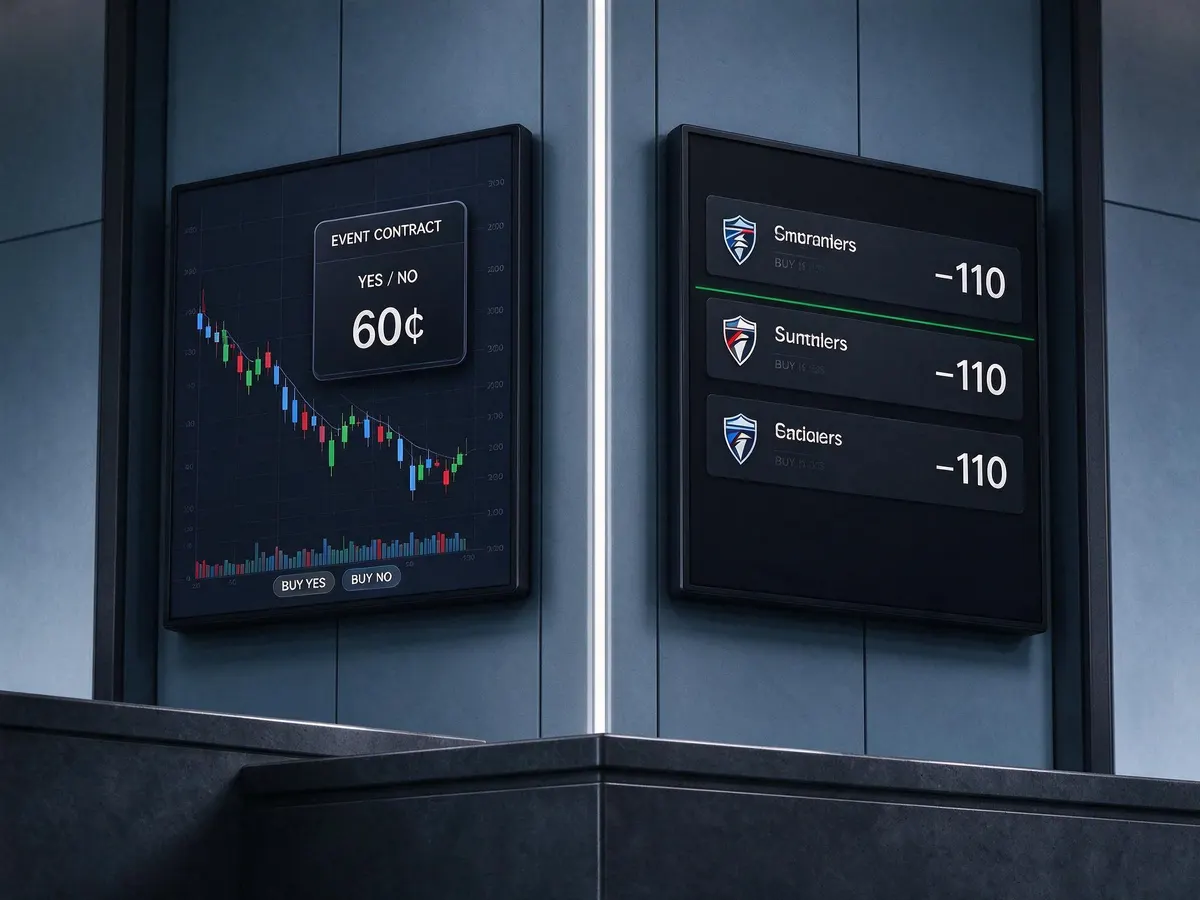
A prediction market is a venue where you buy and sell contracts that pay out depending on whether a stated event happens. That definition is clean, federally flavoured, and doing an enormous amount of work. Strip the vocabulary away and what you are holding on a Sunday afternoon is a position that resolves to either full value or nothing, based on a football score. The prediction markets vs gambling argument lives entirely in that gap between the vocabulary and the mechanics.
The short version of why regulators say this is gambling under a different name
Tribal and state gaming regulators are challenging the claim that sports event contracts are not gambling, on the grounds that the transaction has the same structure as a wager: you pay money, the outcome turns on an event you do not control, and you are paid if you called it right. Platforms counter that these are federally regulated swaps. That counter-argument has already lost once: the Ninth Circuit rejected each of the arguments advanced by KalshiEx LLC and the CFTC that sports event contracts qualify as swaps preempting state law, and allowed Nevada to enforce its ban. Kalshi continues to argue CFTC preemption in other venues, so the question is contested rather than closed.
Follow one contract from purchase to settlement
Say you open an account and put $100 behind a “yes” on a single NFL team winning on Sunday. The market prices that outcome at 60 cents, so your $100 buys roughly 166 contracts. If the team wins, each contract settles at $1 and you are paid about $166. If it loses, each settles at zero and your $100 is gone.
You can also sell your position before kickoff if the price moves, which is the feature most often pointed to as the thing that makes this trading rather than betting. That is a real difference from a traditional parlay ticket, though cash-out features at licensed sportsbooks have blurred it for years.
Where the federal framing comes from
Kalshi and others argue their sports event contracts meet the legal definition of a swap, which would put them under the Commodity Futures Trading Commission rather than under state gaming law. A designated contract market registered with the CFTC operates under federal commodities rules, and federal law can preempt conflicting state regulation of those markets. That is the whole architecture of the defence. It is not a claim that the activity feels different to the user; it is a claim about which statute governs it.
Courts have not accepted it uniformly. The Ninth Circuit rejected each of the arguments advanced by KalshiEx LLC and the CFTC that sports event contracts qualify as swaps, and let Nevada enforce its ban against the platform. Kalshi continues to press federal preemption in other venues, so the swap theory is live litigation rather than settled law.
It also arrived with tailwinds. The source reporting notes prediction markets moved into the mainstream on the back of consumer appetite for sports event contracts and a regulatory posture under the Trump administration that platforms found friendly. Timing matters here as much as legal theory.
The three-part test regulators are actually applying
Most US gambling statutes define a wager through three elements: consideration, chance, and prize. All three generally have to be present. Remove any one and you get something lawful that looks adjacent, which is why sweepstakes promotions exist and why free-to-play pools are legal. Run the $100 trade above through the test and you can see why regulators are not persuaded by the swap label.
Consideration
You paid to participate. The $100 is at risk from the moment the position opens. There is no free entry path, no alternative method of participation, nothing that breaks the link between payment and participation. This element is the easiest of the three for regulators to establish and nobody seriously disputes it.
Chance
This is the contested one, and it is where the “financial innovation” framing does its heaviest lifting. Platforms position users as informed forecasters pricing probability, not punters guessing. Regulators respond that a sports result is determined by the game, not by the trader’s research, and that skill in selection has never immunised an activity from gambling classification. Handicappers at licensed sportsbooks are also skilled. They are still gambling, because the outcome sits outside the participant’s control.
Where the skill versus chance test genuinely bites is in distinguishing poker from roulette, or fantasy contests from a moneyline. It has rarely been read to mean that a well-informed forecast of someone else’s football game stops being a bet.
Prize
Your payout is tied directly to the event outcome and scales with the price you paid, which is functionally identical to decimal odds. Buying at 60 cents to receive $1 is the same economics as taking a price of about 1.67. Call it settlement value or call it a return; the money arrives for the same reason.
Why tribal regulators are objecting loudest
Tribal gaming does not operate on an open commercial licence. Under the Indian Gaming Regulatory Act, Class III gaming, which covers house-banked table games, slots and sports wagering, requires a compact negotiated between a tribe and the state. Those compacts are the product of decades of negotiation, and in many states they contain exclusivity provisions: tribes gained the right to offer certain gaming inside defined boundaries, often in exchange for revenue sharing and tight regulatory conditions enforced by tribal gaming commissions and the National Indian Gaming Commission.
A nationally available app that takes sports positions from a phone anywhere, including inside a tribe’s exclusive market, does not pass through any of that. Tribal regulators see that as an end run around the entire compact framework rather than a new product category.
The deals some tribes have signed with Kalshi have not settled the argument inside Indian Country either. Jason Giles, executive director of the Indian Gaming Association, questioned what those tribes are actually getting: “They all get the Kalshi talking points: ‘This is innovation and we can’t be left behind.’ I don’t know what the innovation is.” Giles’s wider frustration was that nobody pushes back on the innovation claim at all.
That is worth sitting with. The innovation argument is the weakest plank in the platforms’ case precisely because it is a marketing claim, not a legal one. Federal preemption may or may not hold up in court, and in the Ninth Circuit it did not. Whether the product is novel has no bearing on it.
The state objection, and the number that gives it teeth
States are raising a separate set of flags: licensing, age verification, problem gambling safeguards and tax. A licensed sportsbook submits to suitability investigations, funds state regulators, pays gaming tax, and operates under conditions a regulator can withdraw. A platform claiming a different legal category carries none of that cost, which is regulatory arbitrage whatever you think of the underlying legal theory.
The clearest illustration is the age floor. Most prediction markets allow trading from 18. Most states with legal retail and online sports betting set the minimum at 21.
| Requirement | Licensed sportsbook (typical state) | Prediction market platform |
|---|---|---|
| Minimum age | 21 | 18 |
| Regulator | State gaming authority or tribal commission | CFTC, per the platforms’ contested framing |
| State gaming tax | Yes | Not paid as gaming tax |
| State licence required | Yes | Not sought |
| Availability | Only in states that have legalised it | Marketed nationally |
Nevada Gaming Control Board chairman Mike Dreitzer put the point bluntly on the Indian Gaming Association’s weekly webinar, alongside Giles, IGA conference chair Victor Rocha and attorney Scott Crowell. Dreitzer said regulators want the “latest and greatest technology and innovation” in Nevada, but on terms: “if companies want to come to the state, first they must come and get a license like everybody else.” On the product itself he was sharper still: “crime and deception are not innovation,” and 18, 19 and 20 year olds being allowed to wager billions is not innovation either. He also rejected the framing in a letter attributed to former Senator Dean Heller, that the industry should be innovating rather than litigating: “I bristle at that.”
Nevada has attached a consequence to its position. Dreitzer said any participation in prediction markets anywhere makes a company ineligible to participate in Nevada’s gaming industry, which forces operators with licences to choose a side.
Where the line sits today
Unresolved, and genuinely so. Two bodies of law point in different directions: federal commodities law, which platforms argue supports the swap framing and carries preemption force, and state and tribal gaming law, which supports the wager framing and rests on decades of statute and negotiated compacts. The Ninth Circuit has rejected the swap argument and allowed Nevada to enforce its ban, but Kalshi is still arguing CFTC preemption in other venues, so nothing has reconciled the two bodies of law nationally. What exists publicly is a set of regulator positions, the Nevada eligibility stance among the firmest, and competing legal theories still working their way through the courts.
If you want to judge the dispute yourself, the useful question is not whether the product feels like trading. It is whether courts accept that a contract settling on a football score is a swap. One appellate court has already said no. Everything else follows from how the rest answer it.
What to watch
Expect the next developments to come from three places: further public statements and enforcement positions from state regulators and tribal gaming bodies, litigation testing whether federal registration shields these contracts from state gambling law, and state-level restrictions or cease-and-desist activity aimed at access. Watch also whether more tribes sign platform agreements, since each deal weakens the argument that tribal gaming speaks with one voice on this.
One thing the legal label does not change: your $100 was at risk either way. Settlement is binary, losing positions return nothing, and no regulatory classification refunds a misread outcome. Set deposit and loss limits before you start, treat the money as spent rather than invested, and if the activity stops feeling optional, free confidential help is available through the National Council on Problem Gambling, whose National Problem Gambling Helpline can be reached by call or text on 1-800-MY-RESET. Nothing here is legal or financial advice.


